

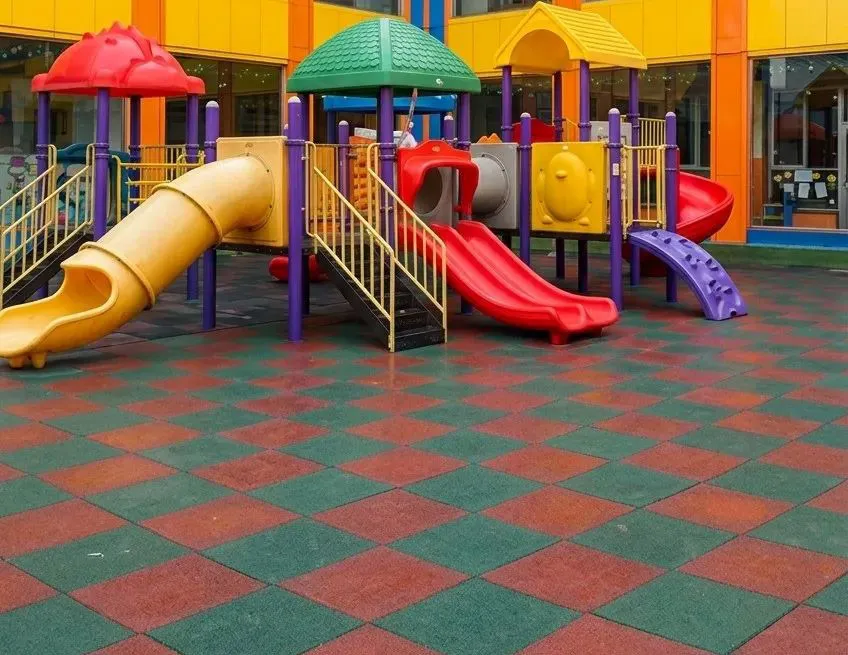
The red-and-green checkerboard is the most recognisable surface in early-years education, and it is usually the first thing parents photograph on an open day. But when buyers evaluate kindergarten rubber flooring, the pattern is the last thing to decide. The floor has one non-negotiable job: when a four-year-old falls off the top of a play structure, the surface has to be the reason nothing worse than a fright happens.
This guide walks through the specification the way a playground contractor would: how to match surfacing thickness to equipment height, why the material composition matters more outdoors than indoors, what indoor areas need beyond softness, and the edges and transitions that determine whether the safety case holds up in year three.
The one job kindergarten rubber flooring cannot fail
Kindergarten rubber flooring is walked on by two hundred children a day in outdoor shoes, used as a craft surface, covered in paint and juice and sand, hosed down — and expected to look cheerful in the photographs that fill the school’s website. Safety flooring that turns grey and slick within two years has failed at both jobs.
But the safety job comes first, and it is measured, not felt. Impact attenuation is a function of thickness, compound and substrate together. There is no reliable way to convert “how soft it feels underfoot” into “how high a child can fall safely” — that conversion is done with tested values for head injury criteria, the metric behind head injury criterion assessments in playground standards.
What this means for a buyer is simple: the specification starts from the equipment, not the catalogue. Measure how high children can fall from each structure, then buy kindergarten rubber flooring tested for that height. A supplier who cannot produce impact test data for a specific product on a specific substrate is selling a feel, not a safety case.
Matching kindergarten rubber flooring thickness to equipment height
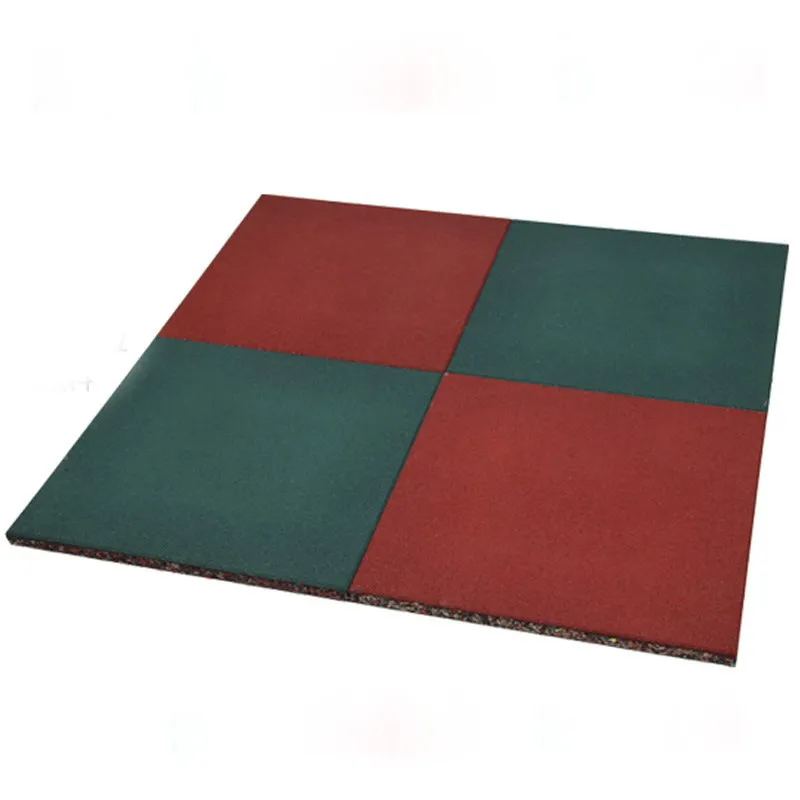
Once the equipment is measured, thickness selection is mostly mechanical. Our High Density Rubber Floor Mats for Outdoor Use run from 20 mm to 50 mm in a 500 × 500 mm tile, which covers an ordinary kindergarten courtyard from the sandpit edge to a climbing tower:
| Play equipment | Typical fall height | Recommended surface |
| Ground-level play, trikes, sandpit surround | under 0.6 m | 20 mm |
| Low climber, slide exit, balance trail | 0.6–1.0 m | 25–30 mm |
| Climbing frame, small tower, swing surround | 1.0–1.5 m | 30–40 mm |
| Multi-level structure | 1.5 m+ | 40–50 mm, or a wet-pour system over a shockpad |
One range of tiles, one colour palette, the whole courtyard — and because the mats are made from 100% high-grade rubber granules, the same kindergarten rubber flooring handles the sandpit surround and the base of the tower without changing suppliers mid-project.
Why 100% rubber granules matter outdoors
Outdoor kindergarten rubber flooring fails in three predictable ways: it hardens under sunlight, it becomes slick when wet, and it sheds granules. This is where composition earns its place in the specification.
UV exposure is the quiet destroyer. A surface that fades from red-and-green to pink-and-grey in two summers has lost more than looks — colour that fades unevenly also signals compound that is hardening. Slip resistance matters most where children are moving fastest and landing hardest: the slide run-out, the gate, the area under swings. Granule loss is both a maintenance complaint and, at the small end, a genuinely unpleasant thing for a toddler to pick up; a fully bound, high-granule-density tile sheds nothing.
The outdoor mats are specified with high elasticity, shock absorption, anti-slip and wear resistance — the four properties a playground actually tests. And because the granules are coloured through the material rather than coated, the checkerboard stays a checkerboard: nothing wears off, because there is no coating to wear.
For the material itself, EPDM rubber is the industry’s reference compound for exactly these reasons — weather resistance, colour stability and elasticity that does not fade with the seasons.
Indoor areas need different evidence
Indoor play rooms, corridors and activity areas bring requirements the courtyard never sees — and first among them is fire performance. Indoor commercial spaces are typically required to meet Class B1 (GB 8624-2012) or Bfl-s1 (EN 13501-1) — flame resistant with low smoke emission — and, as outdoors, that claim must be backed by a test report for the specific product, not a datasheet bullet. The EN 13501-1 classification is the standard reference for European projects.
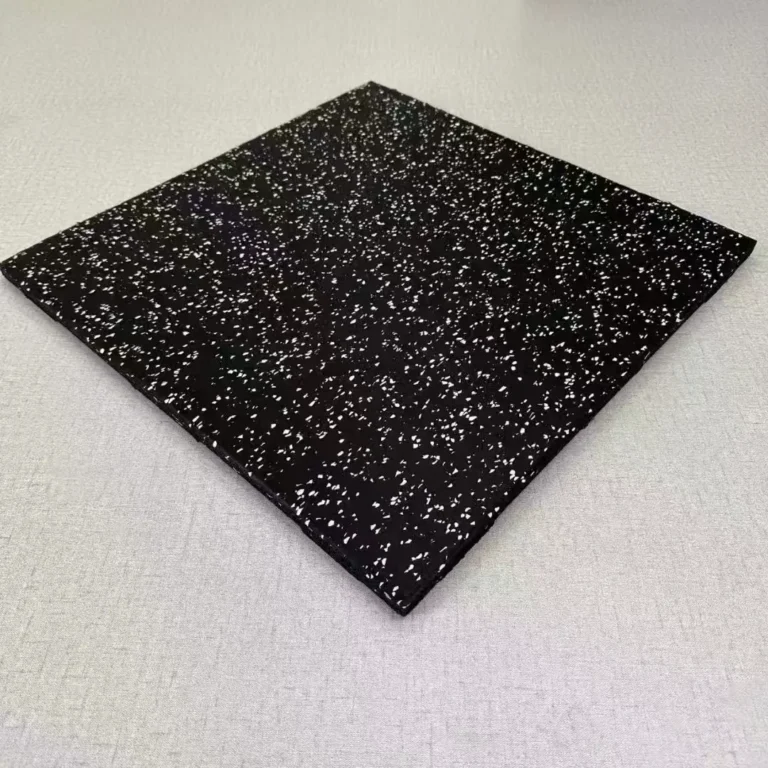
Our Composite EPDM Rubber Mats bring the fire rating plus a dense surface layer — roughly 1,400–1,500 kg/m³ at 65±5 Shore A — that a school can actually clean. Closed, dense EPDM resists paint, glue, juice Our Composite EPDM Rubber Mats bring the fire rating plus a dense surface layer — roughly 1,400–1,500 kg/m³ at 65±5 Shore A — that a school can actually clean. Closed, dense EPDM resists paint, glue, juice and marker, and mops with a neutral detergent. An open, porous rubber holds sand and stains and needs pressure washing to look clean again, which is why some indoor play floors look tired after a single term.
Edges and transitions: where the safety case is won
Kindergarten rubber flooring is a system of levels, and every change of level needs a ramp. This is the part of the package that gets deleted when a project runs over budget, and it is the part that generates incident reports.
A perfect 40 mm play surface with an unprotected 40 mm lip at the gate is still a trip hazard — and children, being children, will test every edge they can find. The Rubber Flooring Transition Strips are manufactured in 15, 20, 25 and 30 mm thicknesses with beveled edges and corner ramps, so a 25 mm play area meets a 15 mm walkway with a smooth bevel rather than a step, and every junction at the gate and the doorway is finished by design.
Through the field itself, loose-laid tiles should be locked with interlocking connectors so running feet cannot shift the tiles and open gaps between them. Fixed perimeters, beveled junctions, no lifted edges: that is the whole safety case, and it costs a fraction of the surfacing.
Colour and pattern that survive children
The checkerboard exists for reasons that go beyond tradition. Two or three colours in a large area hide scuffs, sand and dropped snacks far better than any solid colour, and the grid gives children a visual structure that makes an open courtyard read as a place to play. The outdoor mats come in red, green, black, blue, grey and yellow, with custom colours available for school branding.
Three layout rules that keep the design working for years:
- Darker colours where traffic concentrates — gates, slide exits, the ground under swings — and lighter colours in open areas.
- Two or three colours maximum in a large field. Every extra colour adds seams and visual noise.
- A spare box of tiles from the same batch. Colour shifts slightly between production runs, and a repair six months later will show if the spare came from a different batch.
FAQ
Which thickness do I need under a 1.2 m slide? Around 30–40 mm at the slide exit, extending at least 1.5 m beyond the end of the run-out. Confirm against your local playground standard, using impact test data for the installed build-up rather than a general product claim.
Can the tiles be laid over existing concrete paving? Yes, provided the substrate is sound, level and drained. Standing water is the main cause of outdoor kindergarten rubber flooring failure, so fix drainage before you fix the floor.
Is the surface safe for children who put their hands in their mouths? The mats are made from bound rubber granules with no loose crumb to pick up, and the compound is fully cured before delivery. Ask the supplier for material documentation for your project file, as you would for any surface children contact daily.
How do we clean it without making it slippery? A neutral pH detergent and a mop or scrubber-dryer for indoor surfaces; hosing plus an annual moss check outdoors. Avoid solvent degreasers and oil-based cleaners, which leave a slick film and degrade the surface.
Can we order the school’s colours? Yes. The outdoor mats come in red, green, black, blue, grey and yellow as standard with custom colours supported, and the indoor composite mats can be produced with custom EPDM fleck colours and ratios for branding.
Ready to surface your playground?
Send us your site plan, equipment heights and target areas for a factory-direct quotation. MoXing manufactures outdoor high-density play tiles, indoor composite EPDM mats and matched transition accessories in one facility — 20 production lines, roughly 40,000 m² of plant and 5,000 m² of daily capacity — with OEM/ODM colours, thicknesses and sizes for distributors, school project contractors and playground builders worldwide. Browse the full range in the tiles & mats and accessories categories, or learn more about the factory.