

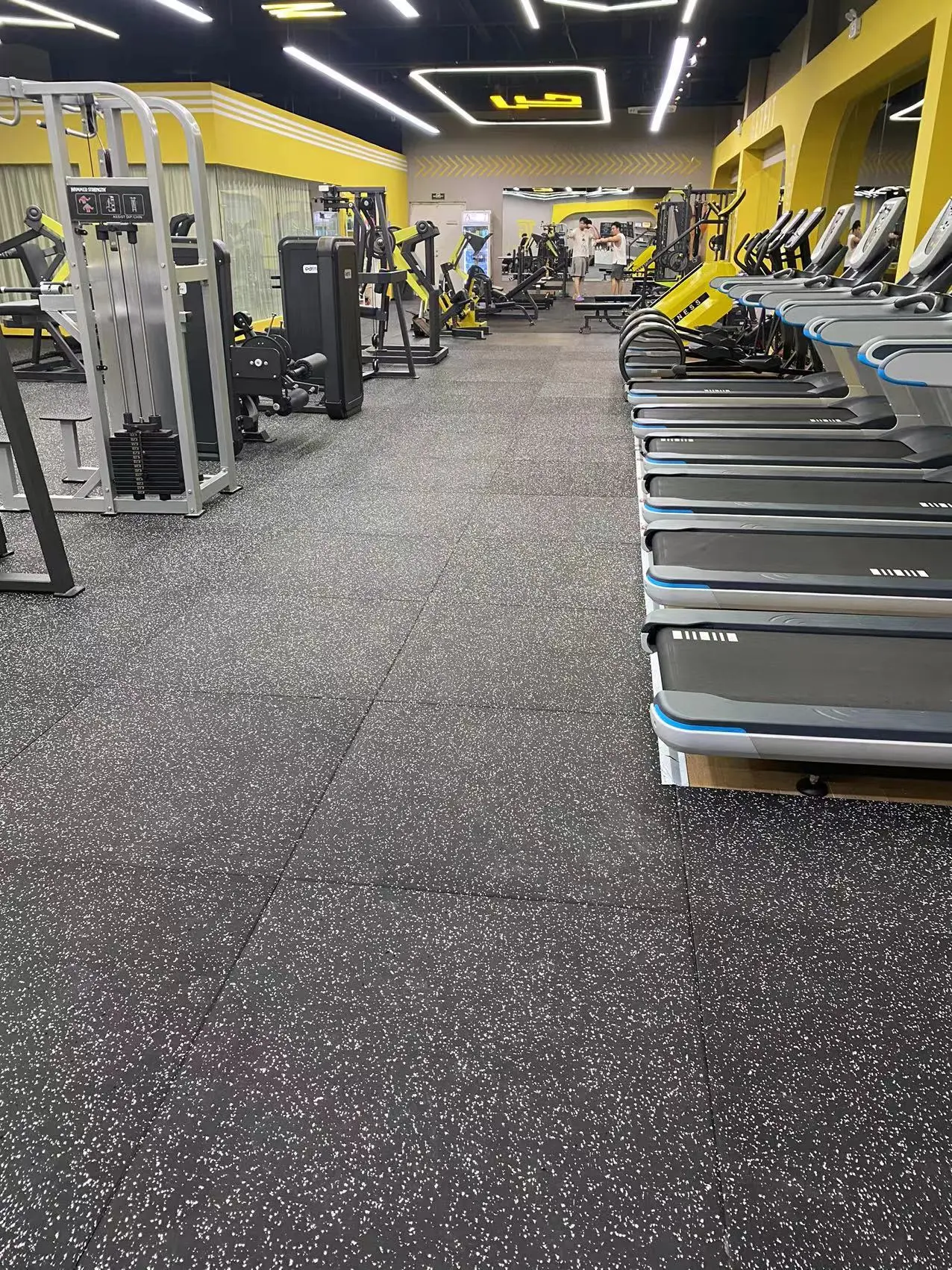
Two gym rubber mats can look identical in a photograph, weigh the same in your hand and quote at the same price per square metre — then behave nothing alike in year three. One still sits flat under a loaded rack. The other has dished into a shallow bowl, gone slick exactly where the chalk lands, and smells faintly of a tyre shop whenever afternoon sun crosses the window. So what are gym rubber mats made of, and why does the recipe decide all of this?
The difference is chemistry, and it is already written down in paperwork most buyers never ask for: the compound data sheet, the compression set figure, the batch record.
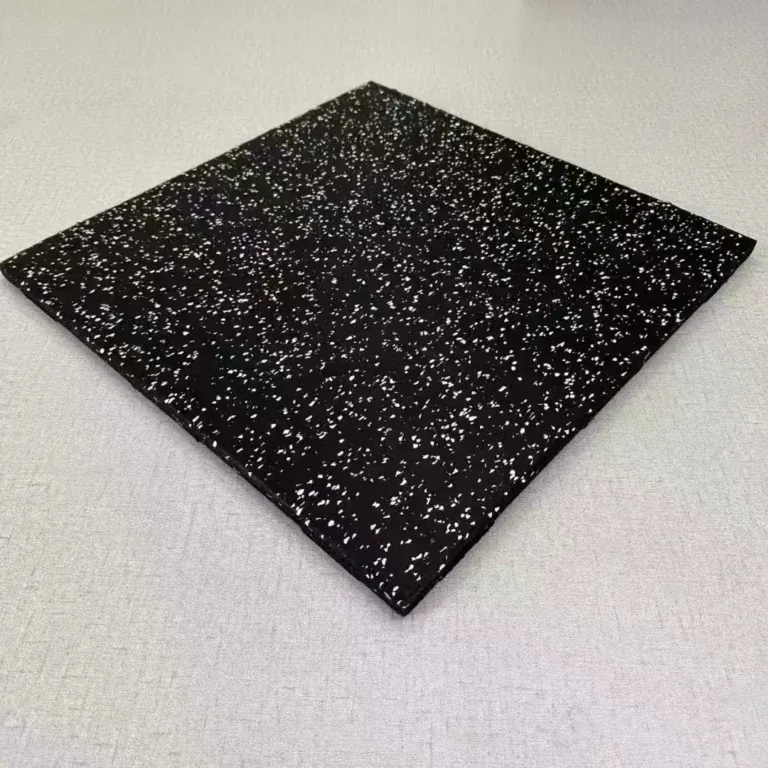
Quick answer: gym rubber mats are made from EPDM rubber, recycled SBR rubber, or both — a dense EPDM surface layer over a recycled SBR base — bonded or vulcanised into tiles, rolls and interlocking mats, usually 4–50 mm thick.
Here is how to read that spec sheet.
What is actually inside a gym rubber mat
Four material families cover almost every gym rubber mat sold today, and the family explains the price, the weight and the lifespan at a glance.
| Material | What it is | What it does in a mat | Where you meet it |
| EPDM | Ethylene propylene diene monomer | UV and colour stable, abrasion resistant | Dense top layers of quality tiles and rolls |
| SBR | Styrene-butadiene rubber | Tough and cheap, poor UV resistance | Base layers, budget mats |
| Recycled tyre crumb | Post-consumer tyre rubber, magnet-separated | Cheapest option; porous; variable; odorous | Bonded “recycled rubber” rolls |
| NBR / TPV | Nitrile rubber or thermoplastic vulcanisate | Oil resistance (NBR), uniform colour (TPV) | Hybrid and garage gyms, light home use |
The saturated backbone is why EPDM survives a south-facing window while SBR chalks and fades: SBR carries double bonds in its chain that UV and ozone attack directly. That single structural fact is why a coloured, sunlit floor is specified in EPDM and a hidden base layer is not.
Recycled content is not a moral question, it is a mechanical one — it is why one mat costs half of another, and also why it holds chalk dust and carries an odour that virgin rubber does not.
Three production routes, three price points
How a mat is formed decides more about its surface than the recipe does.
Compression moulding — tiles. Rubber granules are blended with a binder and colour flecks, then pressed in a heated steel mould that sets thickness precisely and forms the interlocking edge in the same stroke. Slow, tooling-heavy, most expensive — and the only route that reliably delivers a 1,000 × 1,000 mm tile with a flush joint.
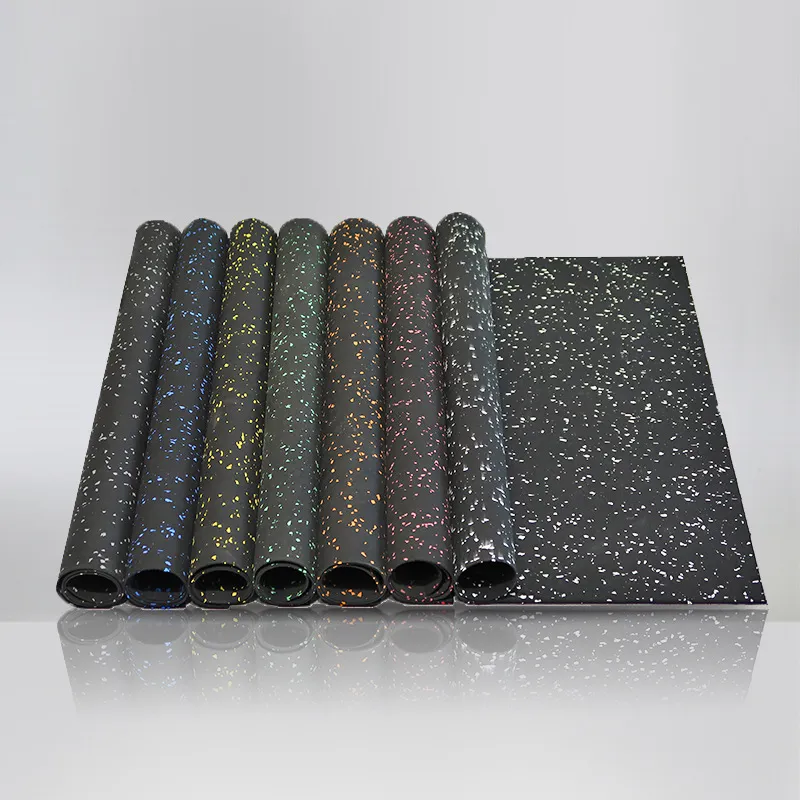
Calendering and continuous vulcanisation — rolls. Compounded rubber is formed into a continuous sheet at controlled thickness, then cured under heat and pressure — the vulcanisation step that cross-links polymer chains and gives rubber its memory. Rolls are trimmed to 1.0 m and 1.25 m widths for seamless cardio rows and studios.
Bonded crumb — the budget roll. Granules are glued with a polyurethane binder and cured at low pressure. Cheap, fast and porous by construction: thickness tolerance is looser, the face absorbs liquid, and the binder is what delaminates under a dragged sled.
A bonded-crumb mat can look convincing in a showroom. It rarely survives a commercial cleaning schedule.
Why the good ones are two layers, not one
A single-compound mat forces a compromise. Dense enough to spread a 200 kg rack’s point load, and it stops absorbing impact, so the bar bounces and the slab transmits noise. Soft enough to absorb a dropped barbell, and it compresses under static load, dishes, and leaves the rack feet rocking.
Layering resolves it, which is why the best gym rubber mats are composite by design:
- Surface layer: high-density EPDM with colour flecks, roughly 1,400–1,500 kg/m³ at 65±5 Shore A — spreads point load and resists abrasion where plates land.
- Base layer: recycled SBR granules at roughly 900–1,000 kg/m³ and 55±5 Shore A — deforms and recovers, absorbing energy before it reaches the slab.
Thickness then becomes a tuning parameter rather than a quality grade, which is why composite EPDM rubber mats built this way are specified from 15 mm to 50 mm in 5 mm steps.
The four numbers that predict failure
A gym rubber mat spec sheet is only useful if you know which lines carry weight.
Density (kg/m³). Mass per cubic metre of compound. Higher density spreads point load further and resists compression under a rack foot. It is also the easiest figure to verify in the field: cut a 100 × 100 mm square and weigh it.
Hardness (Shore A). Measured on the Shore durometer scale, it sets how the surface feels underfoot and how far a dropped plate deforms it locally. 60–70 Shore A is the working band for a gym surface; below 55 the mat reads soft and marks easily.
Compression set (%). The number almost nobody publishes, and the one that decides whether the floor is flat in year three. It measures how much a sample stays squashed after a defined load, time and temperature — commonly 22 hours at 70 °C. As a rule of thumb, under about 25 % is a floor that springs back; over about 35 % is a floor that memorises the rack.
Tensile strength and elongation at break. For a moulded tile these confirm the compound; for bonded crumb they are the honest tell on binder quality, because the binder fails first.
Thickness is a load case, not a quality grade
Thickness answers one question — how much energy a drop can be absorbed and spread — and says nothing about whether the mat stays flat. The load cases differ enough that one thickness of gym rubber mats cannot serve all of them: 4–6 mm roll where machine feet and footfall dominate, 15–20 mm tile for free weights and racks, 25–40 mm in a defined drop zone.
A 25 mm mat across a cardio row costs more than the job requires and makes machine feet rock on a surface too soft to stabilise them. Compare quotations at equal density and equal hardness instead: a firm 20 mm tile with a 1,450 kg/m³ surface will outlast a soft 25 mm tile of unspecified compound in the same weight room — and it ships lighter.
The smell question, answered honestly
New gym rubber mats smell. The honest version is: it should smell for days, not for months, and not in year two.
Three things produce that odour. Residual cure by-products from vulcanisation — sulfur compounds and amines — off-gas as the mat settles. Reclaim oils in post-consumer tyre crumb carry the tyre-shop note that never fully leaves a cheap mat. Some polyurethane binders release solvent as they cure.
None of that is a toxicity verdict on its own, but odour tracks volatile organic compound content closely enough to work as a buying signal. For an enclosed studio or a school, ask for an indoor air emission report against a recognised method such as EN 16516 or AgBB, alongside the fire classification the project requires — Class B1 (GB 8624-2012) or Bfl-s1 (EN 13501-1). Then ventilate for 48–72 hours and clean with a neutral pH detergent; solvent degreasers strip the surface and re-release exactly what you were waiting to disperse.
What wears a mat out — and the five-minute test
Four failure modes account for almost every premature replacement.
Abrasion. Grit underfoot is rubber’s main enemy, and daily sweeping removes most of it.
UV exposure. Unstabilised SBR chalks at a window; EPDM does not, which is why colour belongs in the surface layer.
Chemicals. Solvent degreasers and neat bleach dull the face permanently.
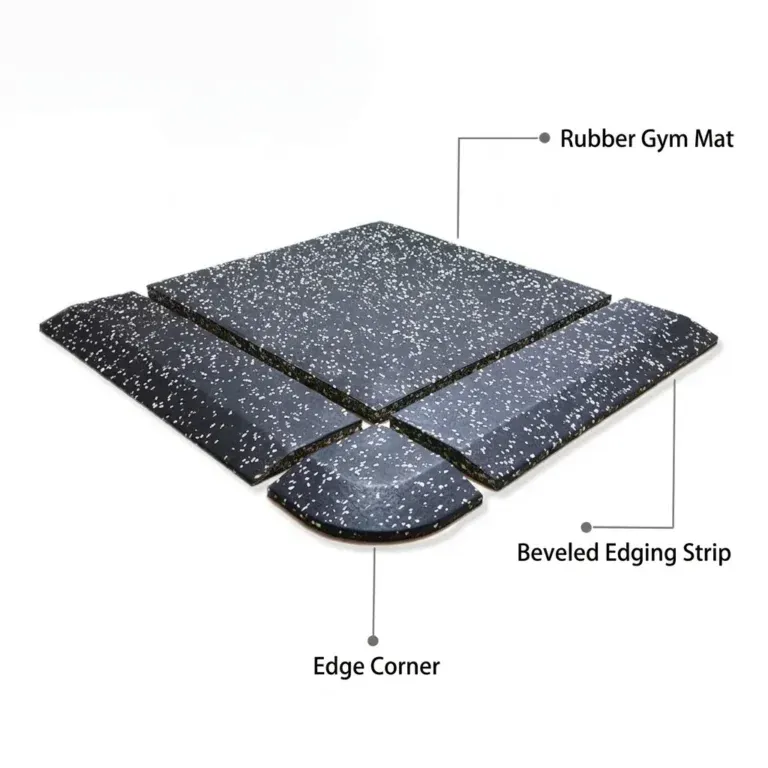
Point load and edges. Rack feet concentrate load for years, and unbewelled edges lift under trolleys and sleds. Transition strips at every junction are the cheapest line on the quote, the first one deleted, and the source of most after-installation complaints.
When a sample arrives, five minutes tells you most of what the data sheet claims:
- Weigh it. Calculate kg/m². At equal thickness, heavier means denser.
- Press a thumbnail in. It should rebound at once; a lingering dent is compression set you can feel.
- Bend a corner hard. Cracking or whitening at the fold signals a brittle compound.
- Look at a cut edge. Uniform granule distribution, no voids, no lighter seam.
- Drop water on the face. A dense closed surface beads it; a porous one darkens and drinks it.
- Smell it, leave it in the sun an hour, smell it again. Intensity that grows with heat points to high reclaimed content.
FAQ
What are gym rubber mats made of? Most are EPDM rubber, recycled SBR rubber, or a composite of both: a dense EPDM surface for abrasion and colour over a recycled SBR base for shock absorption. Cheap mats are bonded tyre crumb held together with a polyurethane binder.
Is EPDM better than recycled rubber? For the visible surface layer, almost always — it resists UV, holds colour and wipes clean. For the hidden base layer, recycled SBR is the sensible engineering choice, because its job is energy absorption, not appearance.
Why does my rubber gym mat smell? Residual cure by-products, reclaim oils in tyre crumb and binder solvents. New mats settle within days to a couple of weeks with ventilation. A mat that still smells in year two contains material you would not have bought had you seen the spec sheet.
How thick should gym rubber mats be? Match thickness to the load: 4–6 mm roll for cardio and machines, 15–20 mm tile for free weights and racks, 25–40 mm for drop zones. Density and compression set decide whether it stays flat.
Can gym rubber mats be laid straight onto concrete? Yes, if the slab is flat to about 3 mm over 3 m, cured, dry and free of rising damp. Loose-lay interlocking tiles need no adhesive on a sound slab; rolls are fully adhered with the manufacturer’s adhesive.
Want the compound data before you order?
Send us your zone layout and target specification, and we will quote with density, hardness and compression set attached — not just a thickness. MoXing manufactures EPDM rolls, composite EPDM tiles, multicolour inlay tiles and matched transition accessories in one facility: 20 production lines, roughly 40,000 m² of plant and 5,000 m² of daily capacity, with OEM/ODM colour, thickness and logo customisation for distributors and project contractors worldwide. Browse the tiles & mats and rolls ranges, the accessories range, or read more about the factory.