

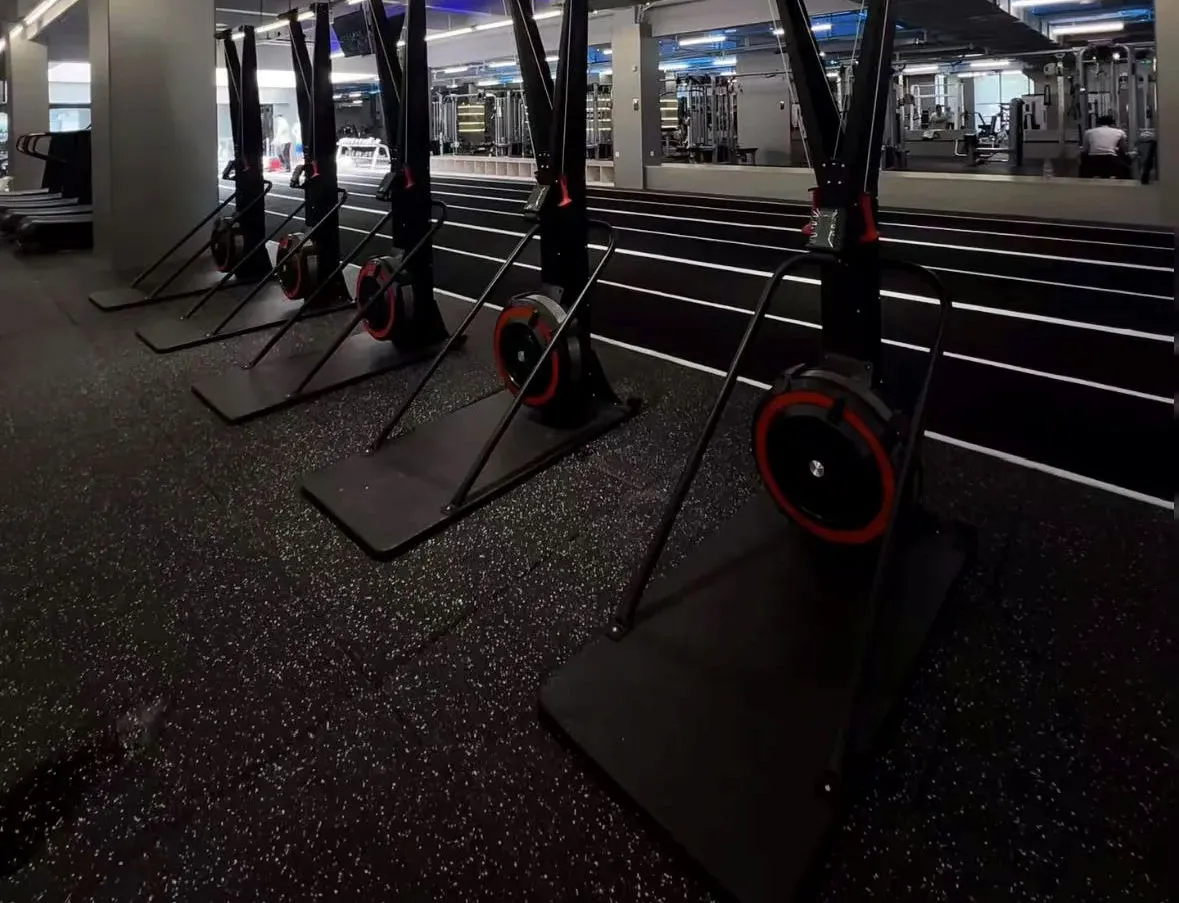
Functional training asks more of a floor than any other fitness format. In a single 45-minute class, the same hundred square metres will host sled pushes, kettlebell swings, box jumps, rope slams, barbell complexes, burpees and a loaded carry — and the next class will lie face-down on it twenty minutes later.
That is the brief every buyer of functional training flooring is really writing: abrasion, impact, hygiene and rapid turnover, all in one room. This guide covers how to zone the floor before you price it, why the sled lane is a wear test rather than a product choice, what the rig area needs in density and thickness, and the marking and transition details that decide whether the floor still looks installed in year three.
What functional training flooring actually has to survive
Functional training is coached in movements, not machines, and the functional training flooring is the equipment every movement touches. Sleds grind along one line hundreds of times a week. Barbells come down from overhead daily, not occasionally. Chalk, sweat and cleaning chemicals arrive in the same hour. And the whole room turns over every forty-five minutes.
Those are four different load cases, which is why the most common and most expensive mistake in this category is buying one product for the whole room. A 10 mm tile is too thin under a drop zone; a 25 mm weight-room tile is unnecessarily expensive — and too soft underfoot — across an open class floor. Facilities that zone their functional training flooring buy less rubber, replace less rubber, and get fewer complaints from both members and cleaners.
Zoning: one floor, four different jobs
The reference layout for a functional facility says it plainly: a long sled or turf lane, a rig wall, an open class area, and circulation through all of it. Map the zones and their square metres first, then buy your functional training flooring to each zone:
| Zone | Product | Recommended spec | What it must survive |
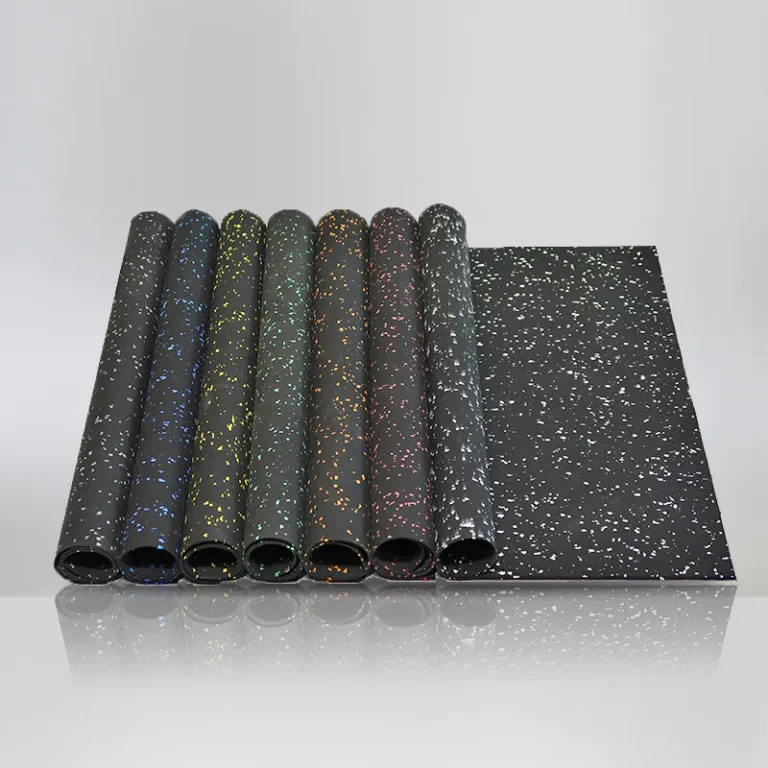
| Sled / turf lane | EPDM Gym Rubber Flooring Roll | 6–10 mm, seamless run, 1.25 m width | Sled skids, constant linear abrasion |
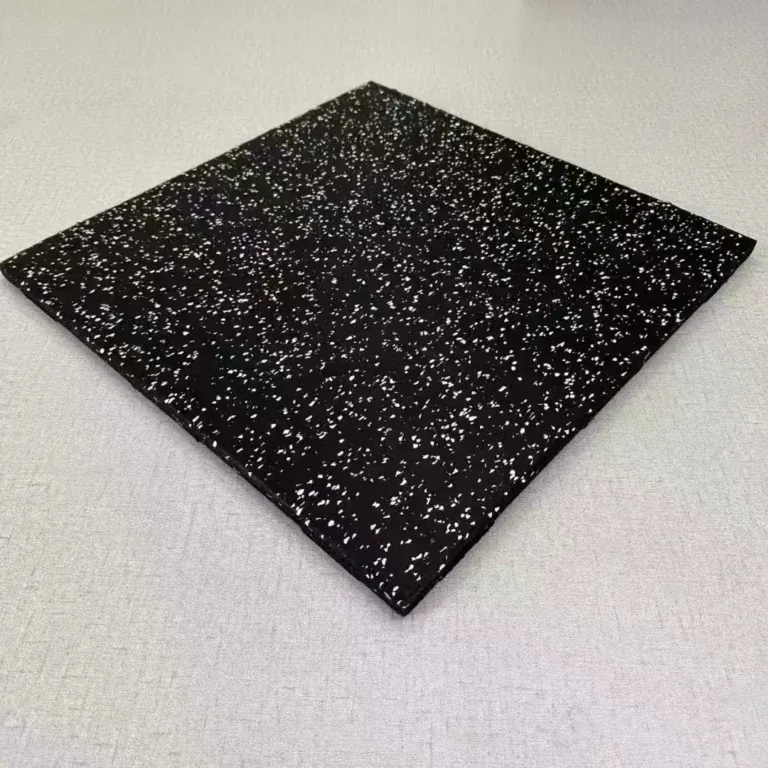
| Rig wall and drop zone | Composite EPDM Rubber Mats | 20–30 mm, 1,000 × 1,000 mm | Dropped barbells, static rack loads |
| Open class floor | EPDM Gym Rubber Flooring Roll | 6–10 mm, welded seams | Box jumps, burpees, sweat, chalk |
| Marking and zoning | Multicolour composite tiles as inlay | 15 mm accent colours | Sled traffic over the markings |
| Every junction | Transition Strips | 15 / 20 / 25 / 30 mm bevels | Trolleys, sleds crossing, trip prevention |
Buying tiles, rolls and edging as one package from one factory is not a convenience argument — it is a performance argument. The thickness steps match, the colours match, and the junctions are flush by design rather than by the installer’s improvisation.
The sled lane: a wear test for functional training flooring
A sled loaded to 100 kg and pushed twenty metres, forty times a day, will destroy a surface that was merely sold as “gym use”. The lane is the highest-abrasion linear traffic any functional training flooring will face, and two details decide whether it survives to year three.
Run it in one continuous piece. Every joint in a sled lane is a place where the material lifts, catches a skid and starts to peel. The EPDM roll comes in 1.0 m and 1.25 m widths and 10–20 m lengths — plan the lane to run the full length of the room in a single pass, and weld any unavoidable seam properly rather than butting it. Where facilities install artificial turf for sled work, the same rule applies: artificial turf belongs in a recessed channel, not laid on top of the rubber, and every edge of that channel needs a ramp.
Recess it, or ramp it. A 10 mm lip under a moving sled is an impact load every single crossing. A beveled transition strip on each side of the lane spreads that load and stops the edge of your functional training flooring being dragged up within weeks.
Under the rig: density first, thickness second
Barbells get dropped here every day, often from overhead. This is the zone where functional training flooring does its heaviest work: absorb the impact so the bar does not bounce unpredictably, spread the static load of a loaded rack for years, and protect the slab so the building does not transmit the hit to the rooms below.
The Composite EPDM Rubber Mats are specified for exactly this: a dense EPDM surface layer at roughly 1,400–1,500 kg/m³ and 65±5 Shore A spreads point load and resists abrasion where plates land, over a recycled SBR base at 900–1,000 kg/m³ and 55±5 Shore A that absorbs the energy. 20 mm is the baseline for a rig wall; 25–30 mm belongs in the drop zone under the heaviest lifting position — as a defined platform, not spread across the whole room.
The failure mode to avoid is a soft, thick tile. It compresses, dishes, and leaves the rack feet rocking within a season, and nobody notices until someone un-racks a loaded bar on an unstable base. Compare quotations at equal density and hardness, not equal thickness — the same logic applies here as everywhere in functional training flooring.
The class floor: chalk, faces and fifteen-minute changeovers
The open class area is where hygiene matters most, because members put their faces on it. That means welded seams rather than butted ones, a closed surface rather than an open one, and edges ramped or coved at the wall so a mop actually reaches the corner.
Chalk and magnesium dust are the specific enemy of open-surface functional training flooring. They work into porous surfaces and make the floor slick exactly where people put their hands down for handstands and burpees. A dense, closed EPDM surface wipes clean between classes; open crumb rubber holds the dust and no amount of mopping brings it back. For commercial fit-outs, indoor fire performance is also part of the specification — typically Class B1 (GB 8624-2012) or Bfl-s1 (EN 13501-1) — so request the test report with the quotation, not after it.
The operational test of a class floor is the changeover: sweep, mop, dry, next class in fifteen minutes. Specify for the cleaning team the facility will actually hire, with a neutral pH detergent and an approved spot cleaner, and put that schedule in writing at order stage.
Marking the floor for coaching
Functional training is coached, and coaching needs lines: lane starts, box positions, shuttle distances, numbered circuit stations. The question is how the lines survive.
Painted lines on rubber wear off in weeks and make the floor read like a school sports hall. Inlaid markings that sit flush with the surrounding floor survive sled traffic. Our Multicolor Composite Gym Rubber Tiles are available in green, blue, yellow, orange, rose red, white and greys with a standard 15% fleck ratio adjustable from 10% to 30%, which makes them practical as inlay markers: a 15 mm strip inlaid flush in the class floor, a contrasting band at the start of each lane, a coloured circle where the circuit assembles.
Design the markings around the class formats the facility actually runs — six stations means six marked stations — and mark them into the functional training flooring at installation, because retrofitting is where the cost doubles.
FAQ
How thick should functional training flooring be? By zone: 6–10 mm roll for sled lanes and class areas, 20 mm composite tile under rigs, and 25–30 mm in the drop zone where barbells are released from overhead. One thickness across the whole room always over- or under-serves at least one zone.
Can a sled lane be made from tiles instead of a roll? It can, but it should not be. Every tile joint across a lane is a place the skid catches and the material lifts. A seamless roll, welded if needed, is the only specification that survives daily sled traffic.
Do I need turf in a functional training facility? Turf is popular for sled pushes and pulls, but it must sit in a recessed channel with ramped edges — not on top of the rubber. Many facilities run a rubber lane alongside a turf lane; both need the same edge treatment.
What fire rating does the flooring need? Indoor commercial training spaces typically require Class B1 (GB 8624-2012) or Bfl-s1 (EN 13501-1). Ask for the test report for the specific product and keep it with the project documentation for the inspector and the insurer.
How do you keep chalk from ruining the floor? Choose a closed, dense surface rather than open crumb rubber, sweep and damp-mop with a neutral pH detergent between classes, and keep solvent degreasers away from the floor entirely — they strip the surface and leave a permanent dull patch.
Ready to build your floor?
Send us your functional training flooring zone layout, total area and class formats for a factory-direct wholesale quotation. MoXing manufactures seamless EPDM rolls, composite drop-zone tiles, multicolour inlay tiles and matched transition accessories in one facility — 20 production lines, roughly 40,000 m² of plant and 5,000 m² of daily capacity — with OEM/ODM colours, thicknesses and markings for facility groups, CrossFit box builders and distributors worldwide. Browse the full range in the rolls, tiles & mats and accessories categories, or learn more about the factory.