

Two suppliers can quote the same thickness at the same price per square metre and deliver floors that behave nothing alike. Buying gym rubber mats is therefore not a price comparison — it is a sequence of six decisions, and the order matters: format, thickness, compound data, quote comparison, supplier vetting, sample test.
Buyers who run the sequence end up paying once. Buyers who skip straight to the quote table usually pay twice: once for the floor, and again in year two for the dished rack platforms, the lifted edges and the mat that never stopped smelling.
This checklist compresses the decisions into the order an experienced buyer would run them. None of the steps takes long; all of them are cheaper before the container ships than after.
Before anything else: write down the loads
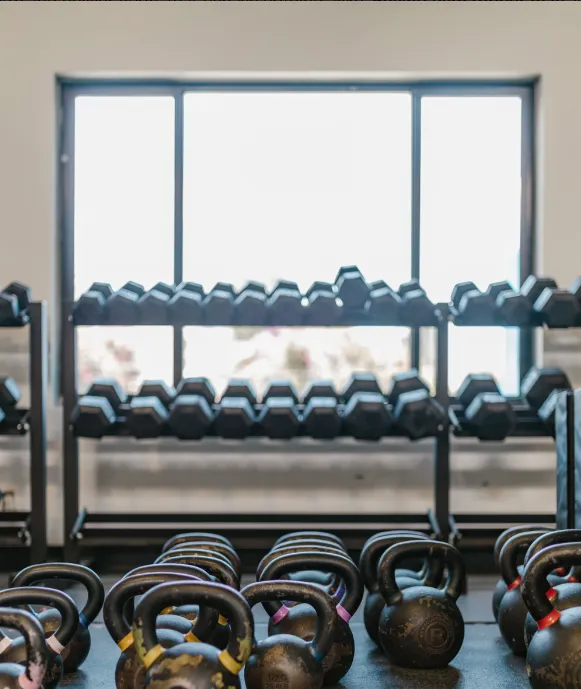
Every decision downstream depends on one document that most buyers never write: a list of what the floor must survive, zone by zone. Cardio machines concentrate weight on small feet. Racks hold static loads for years. Drop zones catch barbells released from overhead. Studios take face-down contact and fifteen-minute changeovers.
Write the zones with their square metres before requesting quotations. This single page does three things: it stops you from buying one thickness for the whole room, it makes every quote you receive directly comparable, and it gives the supplier something to spec against instead of guessing — which is why every experienced buyer starts buying gym rubber mats with this page, not with a search for prices. Our 450 m² installation case study shows what that zone list looks like in practice.
Step 1 — Choose the format: tiles, rolls or interlocking
The format decides your seams, your installation speed and your replacement strategy. There is no best format, only a best format per zone:
| Format | Where it wins | Where it loses | Typical spec |
| Interlocking tiles | Free weights, racks, drop zones; single-tile replacement; no adhesive needed | Visible joints; slower to lay on huge open areas | 500 or 1,000 mm squares, 15–50 mm |
| Rubber rolls | Cardio rows, studios, circulation; minimal seams | Full adhesion required; repairs cut, not swapped | 1.0 / 1.25 m width, 4–12 mm |
| Loose-lay mats | Single stations, home gyms, under treadmills | Edges need ramping; can creep under lateral load | 500–1,000 mm, 6–20 mm |
The common ground: EPDM gym rubber flooring rolls suit long continuous areas, and composite EPDM rubber mats suit point-load areas. Most real gyms buy both — the format decision is per zone, not per project.
Step 2 — Match thickness and density to each zone
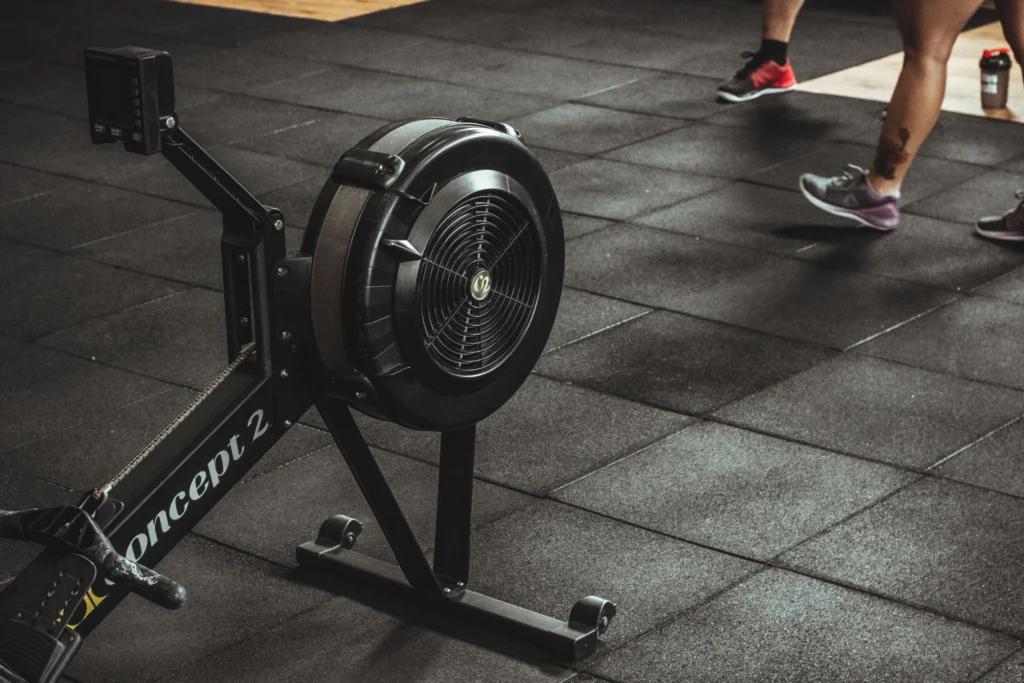
Thickness is the number buyers ask about first and the least reliable guide on its own. What thickness actually does is set how much impact energy the floor can absorb and spread; what density decides is whether the surface stays flat under a rack for a decade.
| Zone | Thickness | What fails if you go thinner | What wastes money if you go thicker |
| Cardio / machines | 4–6 mm roll | Machine feet rock; vibration transmits | Cost, and a surface too soft for machine feet |
| Free weights / racks | 15–20 mm tile | Rack feet dish; tiles compress | Heavier shipment, no extra protection |
| Drop zone | 25–40 mm tile | Bar bounce; slab damage | A third of the budget spent on one room |
The trap to avoid is judging by thickness alone: a firm 20 mm tile with a dense compound outlasts a soft 25 mm tile of unspecified material. The compound logic — dense EPDM surface over resilient recycled SBR base — is explained in our gym rubber mats guide, and the transition strips that join your chosen thicknesses belong in the same order, not a later one — one shipment, matching thickness steps, is the second rule of buying gym rubber mats well.
Step 3 — Demand these five numbers before you commit
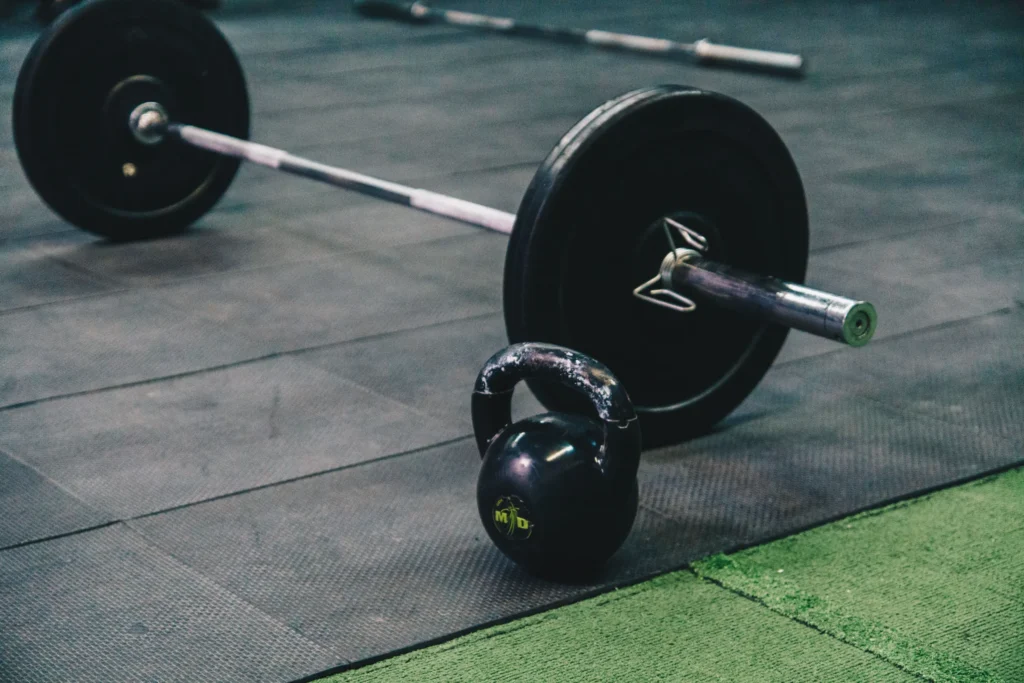
A serious supplier publishes compound data; an unserious one publishes thickness. Demanding the numbers below is the difference between buying gym rubber mats and buying a thickness:
- Density (kg/m³) — point-load performance; roughly 1,400–1,500 for a quality EPDM surface layer.
- Hardness (Shore A) — underfoot feel and local deformation; 60–70 is the working band.
- Compression set (%) — whether rack feet leave a permanent dish; this is the number that predicts year three.
- Tensile strength and elongation — for bonded products, the honest tell on binder quality.
- Fire classification with a test report — typically Bfl-s1 (EN 13501-1) or B1 (GB 8624-2012); the report, not the claim.
If a quotation arrives without these, ask for them. The reply — documents attached, or “we will arrange something” — tells you more about the supplier than any number does.
Step 4 — Compare quotes like for like
The quote stage is where buying gym rubber mats gets expensive, because the cheapest square metre is rarely the cheapest floor. Put every quotation through the same four filters:
- Same compound, same comparison. A price quoted without density and hardness is not a price; it is a lottery ticket. Insist on equal density and hardness before comparing numbers.
- Total shipped weight, not just price. Rubber is heavy. Two quotes can differ by 20% in freight for the same coverage because one compound is denser than the other.
- The hidden lines. Adhesive for roll areas, transition strips at every junction, 5% tile overage, installation labour. Deleting transitions from a quote saves 2% of budget and causes most post-installation complaints.
- Lifespan, not sticker price. A floor replaced in year four at half the unit price cost more per year than the floor that ran eight. Ask what the quotation’s warranty assumes about maintenance.
Step 5 — Vet the supplier, not the product page
Supplier vetting is the least glamorous step in buying gym rubber mats and the one that decides whether the other five survive contact with reality. Product photos are identical across the industry; the difference is behind them. Five checks, in ascending order of effort:
- Test reports in the supplier’s own name — fire, slip, and emissions if the project is enclosed. Resold reports from another factory are a warning sign.
- Batch consistency records — the tiles arriving in month six must match month one; ask how that is controlled.
- Sample policy — a serious factory sends compound-cut samples, not just pretty surface shots, and does it free.
- Customisation capability — colour, thickness steps, logos and inlay markings made to order indicate a manufacturer rather than a trader.
- Factory evidence — production lines, plant size, daily capacity, and whether OEM/ODM is a service or a slogan. Our own figures: 20 production lines, roughly 40,000 m² of plant, 5,000 m² of daily capacity — verifiable on a factory visit.
Step 6 — Run the sample test before the container ships
The last gate costs five minutes and has caught every bad batch we have ever seen a buyer avoid. When the sample arrives: weigh it (kg/m² against the spec), press a thumbnail in (rebound, not a lingering dent), bend a corner (no cracking or whitening), inspect the cut edge (uniform granules, no voids, no seam), drop water on it (beads on a dense surface, soaks into a porous one), and smell it before and after an hour in the sun (heat should not intensify the odour).
Then order against the tested sample — and keep it. This last gate is what separates buying gym rubber mats from hoping: the sample is the quality standard the delivery is judged against, and the fastest way to resolve any dispute about what was agreed.
FAQ
What should I look for when buying gym rubber mats?
Six decisions in order: zone loads first, then format per zone, thickness matched to each zone’s load, compound data (density, Shore A, compression set), a like-for-like quote comparison, and a five-minute sample test before the container ships.
How much do gym rubber mats cost? Price per square metre varies with compound, thickness and order volume — and comparing on price alone is the most expensive mistake in the category. Compare at equal density and hardness, and add freight, adhesive, transitions and 5% overage before judging which quote is cheaper.
Which is better: interlocking tiles or rubber rolls? Neither, universally. Tiles win where point loads are high and single-tile replacement matters (free weights, racks, drop zones); rolls win where seams should be minimised (cardio rows, studios). Most gyms buy both, zoned.
Do I need samples before ordering gym rubber mats? Yes — always. A compound-cut sample lets you run the five-minute test (weight, rebound, bend, edge, water, odour) and becomes the quality standard the delivery is judged against.
What documents should a gym flooring supplier provide? Fire test report matching your project’s requirement (Bfl-s1 / EN 13501-1 or B1 / GB 8624-2012), slip resistance data, compound data sheet with density and hardness, and batch consistency records. A supplier who produces these without hesitation tests routinely; one who promises to “arrange something” does not.
Ready to buy with the spec attached? Buying gym rubber mats from MoXing starts with your zone list: send it with your target specification, and we will return a quotation with density, hardness, compression set and fire documents attached — plus a compound-cut sample before you commit. MoXing manufactures interlocking composite tiles, seamless EPDM rolls, multicolour inlay tiles and matched transition accessories in one facility — 20 production lines, roughly 40,000 m² of plant and 5,000 m² of daily capacity — with OEM/ODM colour, thickness and logo customisation for distributors, gym chains and fit-out contractors worldwide. Browse the tiles & mats, rolls and accessories categories, or talk to the factory.