

Quick answer: heavy duty gym flooring is specified by the worst thing that will ever hit it — a loaded barbell dropped from hip height or above. 20 mm dense composite handles dumbbell and rack work; 25–30 mm handles deadlift drops; and overhead Olympic lifts want either a 30 mm-plus platform build or a dedicated lifting platform, not a thicker roll of the same mat.
“Heavy duty” is the most abused phrase in gym flooring. Catalogues attach it to products that dented under a rack foot in six months, and buyers attach it to rooms where nobody will ever drop a barbell. Both errors come from treating the phrase as a quality grade instead of a load class. Heavy duty gym flooring is a floor matched to a specific worst-case load — and the way to get there is to do the arithmetic that the catalogue skips. This guide does that arithmetic: what a drop actually delivers, what a rack foot actually presses, where thickness works and where it stops working, and how the building underneath limits the whole decision.

What a drop actually delivers
A floor does not experience “a 100 kg barbell”. It experiences energy, delivered at a rate, into an area — and each of those three terms changes the specification. The impact of a dropped bar is the clearest way to see it.
Take a 100 kg bar dropped from 0.9 m — a controlled deadlift drop. Gravitational energy is mass × height × g: roughly 880 joules. Now compress that energy into the contact patch — two Olympic plates, each touching down over roughly 30 cm² of rubber. The floor must absorb 880 J through about 60 cm² of surface in a few milliseconds, decelerating the bar through the rubber’s deflection depth. If the mat deflects 10 mm, the average resisting force is in the tens of kilonewtons — several times the bar’s static weight, applied for an instant at a bearing pressure into the tens of megapascals at the plate edge.
This is why a floor can shrug off a 300 kg leg press — a huge static load spread over broad feet — and still dent under a dropped 10 kg dumbbell, whose small head concentrates the same game into a few square centimetres. Heavy duty gym flooring is therefore judged on energy absorption per contact area, not on tonnage.
Three practical consequences follow:
- Plate diameter matters. A 45 cm competition plate lands its edge differently than a small-diameter training plate; thinner contact geometry concentrates load.
- Drop height outranks weight. 60 kg from overhead delivers more energy than 100 kg from the hip.
- Deflection depth is the design target. The rubber must have enough thickness to deflect through the energy without bottoming out — which is the real meaning of thickness, and the reason the zone logic in our thickness guide reads as it does.
The exercise × thickness matrix
Instead of zones, spec the floor by the worst exercise each area will ever host:
| Worst-case exercise | Minimum dense composite | What fails if thinner |
| Machine work, cardio | 6–8 mm | Comfort only; nothing structural |
| Dumbbells set down by hand | 15 mm | Head-edge dents in the free-weight lane |
| Heavy rack work, no drops | 20 mm | Rack-foot creep under long static loads |
| Deadlift drops to the hip | 25 mm | Surface set at the plate edge within a year |
| Olympic weightlifting from overhead | 30 mm+ or platform | Bottoming out; energy reaches the slab |
Two reading rules. First, the column is the worst exercise, not the average one — a strength corner that hosts one cross-training class a week is specified by that class. This is the discipline that keeps heavy duty gym flooring honest: the floor is bought for the heaviest thing that will ever happen to it, not for the average Tuesday. Second, thickness does the absorbing only if the compound underneath does the recovering: at 1,000 kg/m³ and above, a dense composite returns to shape after each drop; a light, porous crumb mat at the same thickness compresses into a permanent dish. Density and thickness are a package deal — the material explainer covers why the two numbers must be quoted together.
Where thickness stops helping: the platform problem
Beyond about 30 mm, buying more thickness stops making engineering sense. Thicker mats cost more per square metre, edge up into trip hazards, and — the real limit — keep handing the drop energy to the same thin surface layer. Overhead Olympic lifting is where this limit arrives, and the industry’s answer is not a thicker mat but a built-up platform:
- A timber or steel frame distributes load over metres instead of centimetres;
- Two or three layers of 18–20 mm dense tile or deck, screwed — not glued — so the assembly can be refurbished layer by layer;
- A centre insert of softer rubber exactly where the bar lands, replaced on a schedule instead of the whole floor.
The platform turns the floor’s problem from “absorb 1,000 J in one spot of one mat” into “spread 1,000 J across a metre of assembly”. That is why serious lifting facilities buy platforms, not 50 mm mats — and why a supplier who answers every load question with “just go thicker” is telling you they do not do the arithmetic.
Static loads: the rack foot question

Drops get the attention; static loads do the slow damage — and heavy duty gym flooring has to answer for both. A rack holding two loaded barbells plus storage pins can carry 500–700 kg on four small feet. At 6 cm² per foot, that is a contact pressure approaching 2–3 MPa sustained, indefinitely.
Sustained load behaves differently from impact. Where a drop tests energy absorption, a rack foot tests creep — slow, permanent deformation under load held for months. Three defences, none of them thickness:
- Density. High-density compound resists creep; low-density crumb slowly flows out from under the foot.
- Foot geometry. Wide rubber rack feet or spreader plates multiply contact area and divide the pressure for free.
- Compression set data. The spec line that predicts year-three dishing is compression set, not thickness — ask for it per batch, and test it the way our buying guide describes.
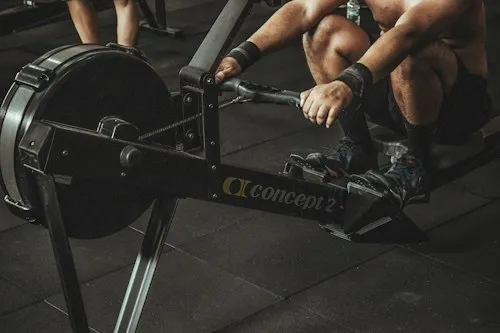
Machines add their own wrinkle: line loads travel through small castors and levelled feet, and they move — so the floor sees a rolling point load, which is why machine lanes tolerate thinner compound but wear their surface faster. The rower in any commercial gym sits on the same principle as every other static load: wide contact wins.
The substrate is the real limit
Heavy duty gym flooring ends at the building. A drop that the floor absorbs happily still hands a fraction of its force to the slab beneath, and the slab gets a vote:
- Slab-on-grade (ground floor, 150 mm+ structural slab): takes nearly anything short of full Olympic platforms. Drops, racks, sleds — spec the floor and go.
- Suspended concrete (first floor and up): usable for heavy training, but drop energy becomes structure-borne noise and vibration for the rooms below. This is where the acoustic assembly in our boutique studio case study earned its keep — underlay, perimeter isolation, and honest ΔLw targets.
- Suspended timber (timber joists, many garages-over-rooms and home conversions): the joists, not the rubber, set the limit. Repeated drops can crack ceiling plaster below and work fixings loose; the right answer is no barbell drops at all — machine and dumbbell training only.
A supplier who never asks what the floor sits on is selling rubber, not a floor system. The question costs one email; skipping it has ended more projects than any compound defect. And once installed, the floor’s ability to keep absorbing drop after drop depends on the care routine in our cleaning guide — grit-loaded surfaces wear, and wear thins exactly the layer doing the work.
What “heavy duty” should come with
Hold any heavy duty gym flooring quotation to four documents, not adjectives:
- Density per batch — ≥ 1,000 kg/m³ for any area that sees drops or racks.
- Compression set value — the number that predicts permanent dishing under racks and plate edges.
- Residual indentation after indentation/impact testing — how much of a controlled dent remains after recovery time; this is the closest thing to a drop test you can put on paper.
- A warranty that names drop zones — a warranty that quietly excludes “damage from dropped weights” is not a heavy duty warranty, whatever the header says.
Price the floor on those four lines and the phrase “heavy duty” regains its meaning: heavy duty gym flooring becomes a floor whose worst day — the day someone drops something they shouldn’t — is already in the specification, priced and documented.