

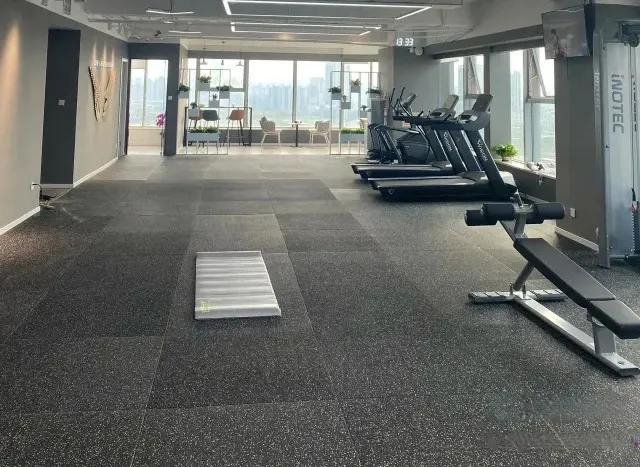
Choosing commercial gym rubber flooring is one of those purchases that looks simple from a catalogue and turns out to be a system decision on site. The floor in a busy gym absorbs dropped dumbbells, carries rack loads for years, takes sweat and chalk and cleaning chemicals, and still has to look sharp in the photos that win the next membership sign-up.
This guide walks through the decision the way an experienced installer would: how to zone the floor before you buy anything, which thickness and product type belongs in each zone, what the density and hardness numbers actually tell you, which fire and safety ratings a commercial project needs, and the finishing details that separate a floor that lasts from a floor that gets replaced in year two.
Why one product never covers a whole gym floor
The most common mistake in this category is also the most understandable: finding one product you like and ordering it for the entire floor. A 10 mm tile that feels solid underfoot in the showroom will compress and dish under a loaded power rack. A 25 mm weight-room tile across an entire cardio row costs far more than the job requires and makes machine feet rock on a surface that is too soft for them.
A commercial gym is several different load cases sharing one open plan. Cardio machines concentrate weight on small feet and generate constant vibration. Free-weight areas take static rack loads for years and occasional violent impacts. Studios need a continuous surface people can move across at speed — and lie on. Circulation takes trolleys, wet shoes and soil from the street.
Zoning the floor first, then buying to each zone, is what turns the flooring from a recurring maintenance cost into a one-time purchase. Write the zones down with their square metres before you request quotations, and every quote you receive afterwards becomes comparable.
Matching thickness and product to each zone
Once the zones exist, the product selection is mostly mechanical. The table below reflects the specifications of our own product lines, which are manufactured to work together:
| Zone | Product | Recommended spec | What it must survive |
| Cardio / machine rows | EPDM Gym Rubber Flooring Roll | 4–6 mm, 1.0 / 1.25 m width, 10–20 m length | Machine feet, vibration, footfall |
| Free weights / racks | Composite EPDM Rubber Mats | 20 mm, 1,000 × 1,000 mm, interlocking | Static rack loads, dropped dumbbells |
| Deadlift / drop zone | Composite EPDM Rubber Mats | 25–40 mm | Repeated barbell drops from overhead |
| Group class / studio | EPDM Gym Rubber Flooring Roll | 6–10 mm, welded seams | Continuous traffic, face-down contact |
| Perimeters and junctions | Rubber Flooring Transition Strips | 15 / 20 / 25 / 30 mm bevels and corner ramps | Trip prevention, edge protection |
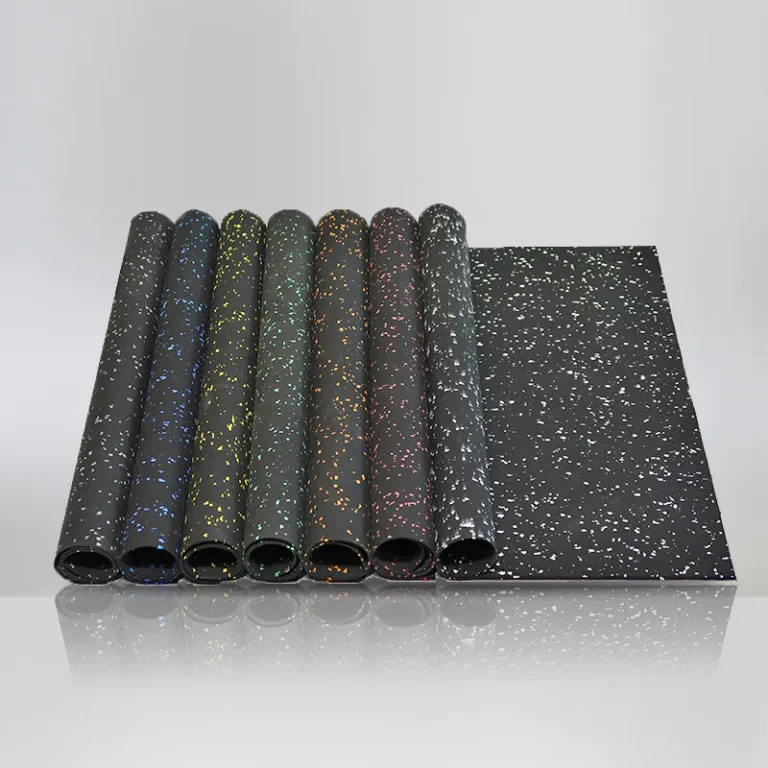
A few points worth noticing in that table. The roll comes in widths of 1.0 m and 1.25 m precisely because wider coverage means fewer seams — and every seam in a gym floor is a place that can lift, catch and fail. The tile comes in 500 × 500 mm and 1,000 × 1,000 mm because large rooms lay faster with big tiles while small rooms and staircases are easier work with small ones. And the transition strips are manufactured in the same thickness steps as the tiles, so a junction between a 20 mm weight zone and a 6 mm cardio row is flush by design rather than by the installer’s improvisation.
What density and hardness data tell you before you buy
Thickness is the number buyers ask about first. Density is the number that predicts whether the floor is still flat in year three. Under a static rack load, a soft, thick tile compresses slowly over months, develops a dish, and leaves the rack feet rocking — which is a lifting-safety problem as much as an aesthetic one, and no amount of later maintenance reverses it.
This is why the specification of the Composite EPDM Rubber Mats publishes the full compound data rather than a single millimetre figure:
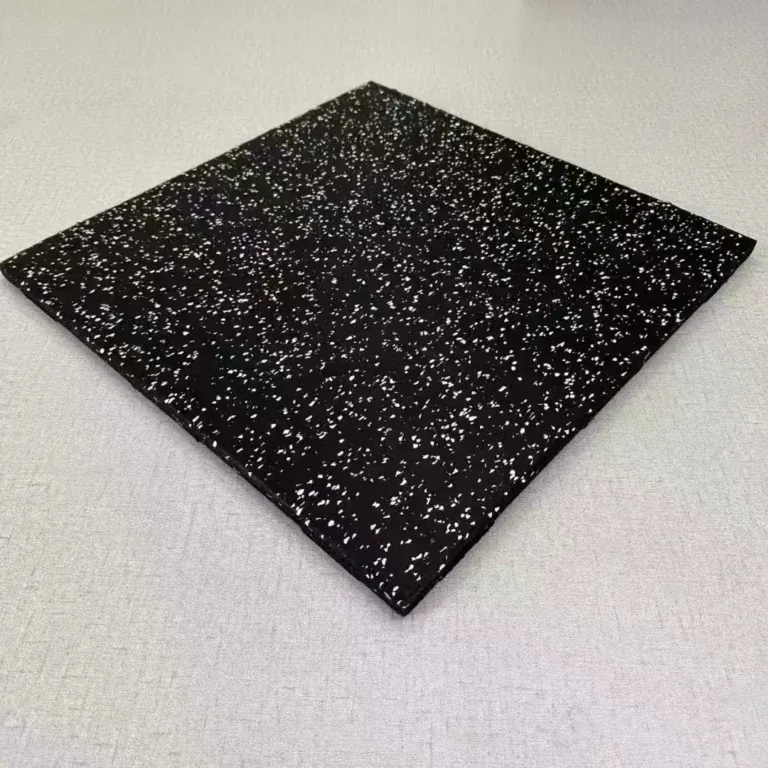
- Surface layer: high-density EPDM with colour flecks, ~1,400–1,500 kg/m³, 65±5 Shore A
- Base layer: recycled SBR granules, ~900–1,000 kg/m³, 55±5 Shore A
- Thickness range: 15–50 mm in 5 mm increments, custom thicknesses available
The dense surface layer spreads point load and resists abrasion where plates land. The resilient base absorbs the energy of a dropped weight. Hardness, measured on the Shore durometer scale, is what keeps the surface from feeling soft underfoot while still absorbing impact through the base.
When you compare quotations from different suppliers, compare them at equal density and equal hardness — not at equal thickness. A firm 20 mm tile with a 1,400 kg/m³ surface will outlast a soft 25 mm tile of unspecified compound in the same weight room, and it will cost less to ship.
Fire ratings and safety standards for commercial projects
Commercial fitness spaces are typically required to meet Class B1 (GB 8624-2012) or Bfl-s1 (EN 13501-1) — flame resistant with low smoke emission. These ratings are usually a condition of building approval and insurance, and they must be evidenced by a test report for the specific product, not by a claim on a website. The EN 13501-1 classification is the standard reference across European projects, and your local authority will tell you which evidence it accepts.
Before signing an order, ask the supplier for:
- The fire test report matching the standard your project requires
- Slip resistance data, tested wet as well as dry for entrance areas
- Batch consistency records, so the tiles delivered in month six match the ones delivered in month one
A supplier who can produce these documents without hesitation has them because they test regularly. A supplier who promises to “arrange something” is telling you the testing was never done.
Installation details that protect the investment
The field of tiles and the runs of roll are the visible part of a gym floor; the details around them are what keep it looking installed.
- Interlocking edges hold the tile field together under lateral loads — sleds, dragged benches, loaded carries — and allow a single damaged tile to be lifted and replaced instead of cutting a patch.
- Transition strips remove the trip lip at every doorway and every junction between different thicknesses. They are inexpensive, they are the first item deleted when a project runs over budget, and they are where most post-installation complaints originate.
- Interlocking connectors lock the base joints of loose-lay tiles so the field does not creep and the edges do not curl under traffic.
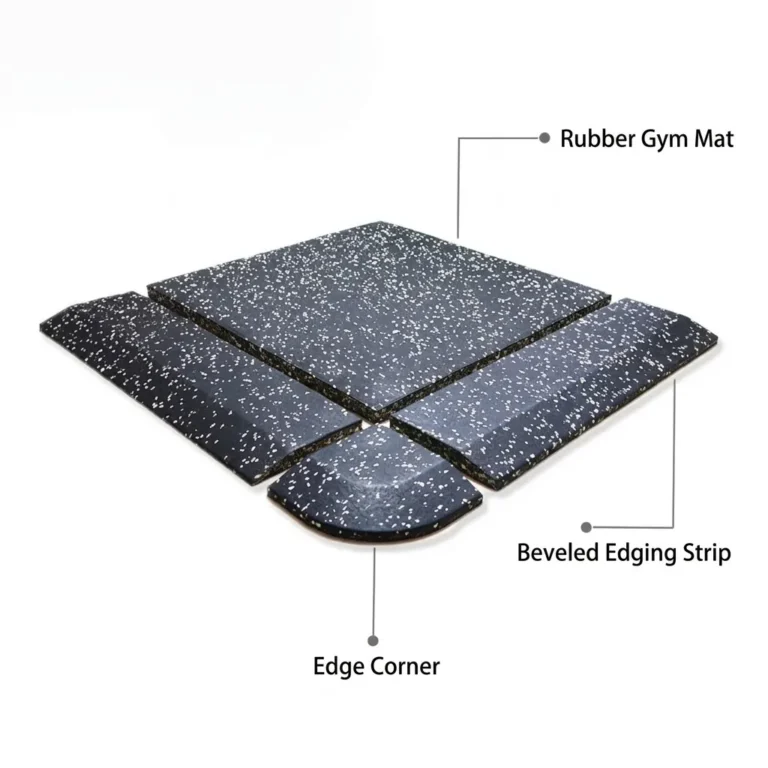
None of these parts is decorative. A 20 mm weight zone that meets a 6 mm cardio roll without a beveled strip creates a 14 mm step in a space where people walk while carrying loaded bars.
Rubber gym floor maintenance that actually preserves the surface
A well-specified floor is easy to maintain, but “easy” still means a routine. Sweep or dust-mop daily — grit underfoot is abrasive rubber’s main enemy. Damp-mop weekly with a neutral pH detergent, and keep an approved spot cleaner for chalk, sweat and oil.
Two things shorten a floor’s life faster than anything else. The first is solvent-based degreasers, which strip the surface and leave a permanently dull patch. The second is unmanaged chalk: magnesium dust works into open surfaces and makes them slick exactly where members put their hands down. A closed, dense surface wipes clean — which is one more reason the compound data in the previous section matters.
If the gym sits on an upper floor, remember that flooring reduces airborne impact noise but does not solve structure-borne transmission on its own; acoustic performance belongs to the floor build-up, and it should be discussed with the factory before the project is priced.
FAQ
How thick should commercial gym rubber flooring be? It depends on the zone: 4–6 mm roll for cardio areas, 20 mm composite tile for free-weight areas, 25–40 mm for drop zones where barbells are released from overhead. One thickness across the whole gym always over- or under-serves at least one zone.
Are rubber tiles or rubber rolls better for a gym?
Use both, zoned. Rolls suit long, open areas — cardio rows, studios, circulation — where seams should be minimised. Interlocking tiles suit free-weight and rack areas, where point loads are high and single-tile replacement matters.
What fire rating does gym flooring need? Class B1 (GB 8624-2012) or Bfl-s1 (EN 13501-1) is the usual requirement for commercial fitness spaces. Request the test report for the specific product and keep it with the project documentation for the fire inspector and the insurer.
Can gym rubber flooring be installed over concrete? Yes. The substrate should be flat (typically within 3 mm over 3 m), cured, dry and free of rising damp. Loose-lay interlocking tiles need no adhesive on a sound slab; rolls are fully adhered with the manufacturer’s recommended adhesive.
How long does commercial gym rubber flooring last? With correct density, correct thickness per zone and neutral-pH cleaning, a quality tile floor in a busy commercial gym routinely reaches eight to ten years before wear zones need replacing — and with interlocking tiles, only the worn zones need replacing.
Ready to spec your floor?
Send us your zone layout, total area and target specification for a factory-direct wholesale quotation. MoXing manufactures composite EPDM tiles, multicolour gym tiles, seamless rubber rolls and matched transition accessories in one facility — 20 production lines, roughly 40,000 m² of plant and 5,000 m² of daily capacity — with OEM/ODM colour, thickness and logo customisation for distributors, gym chains and project contractors worldwide. Browse the full range in our tiles & mats, rolls and accessories categories, or learn more about the factory.