
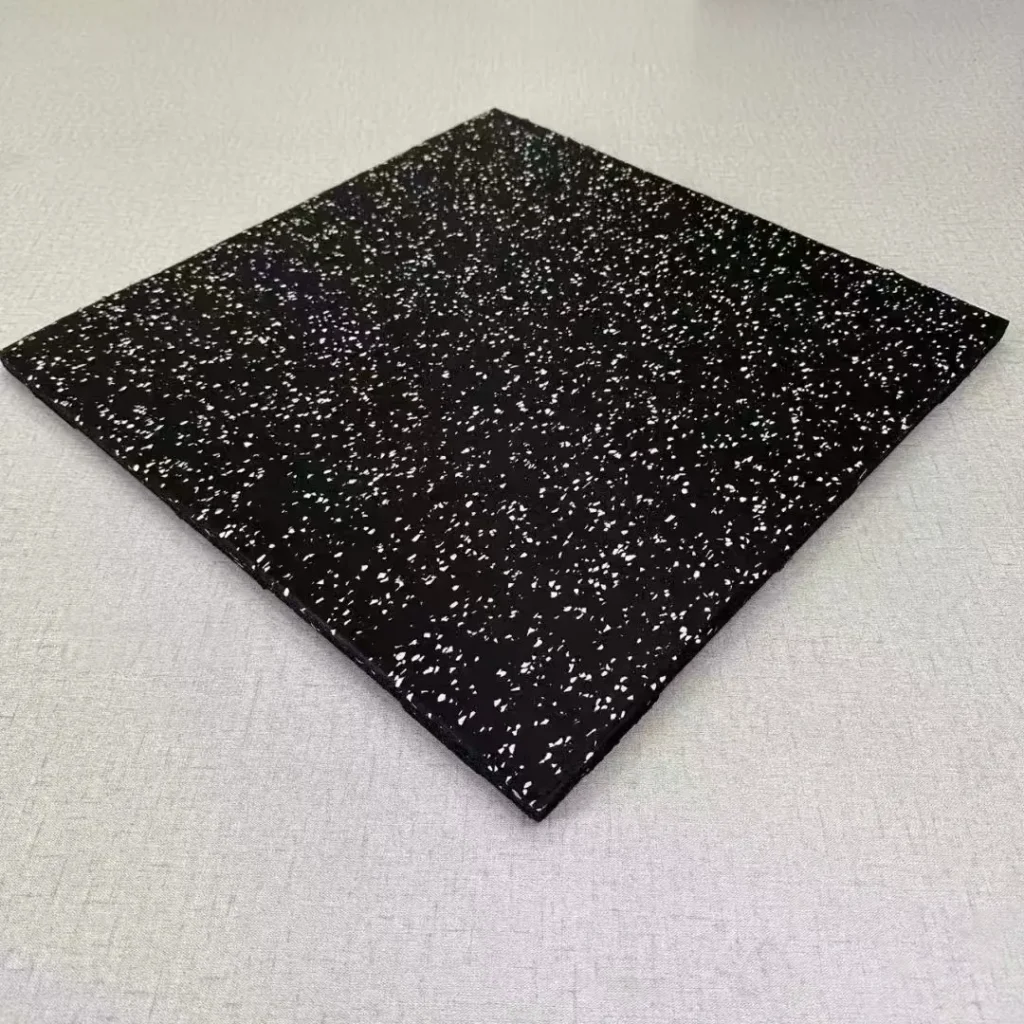
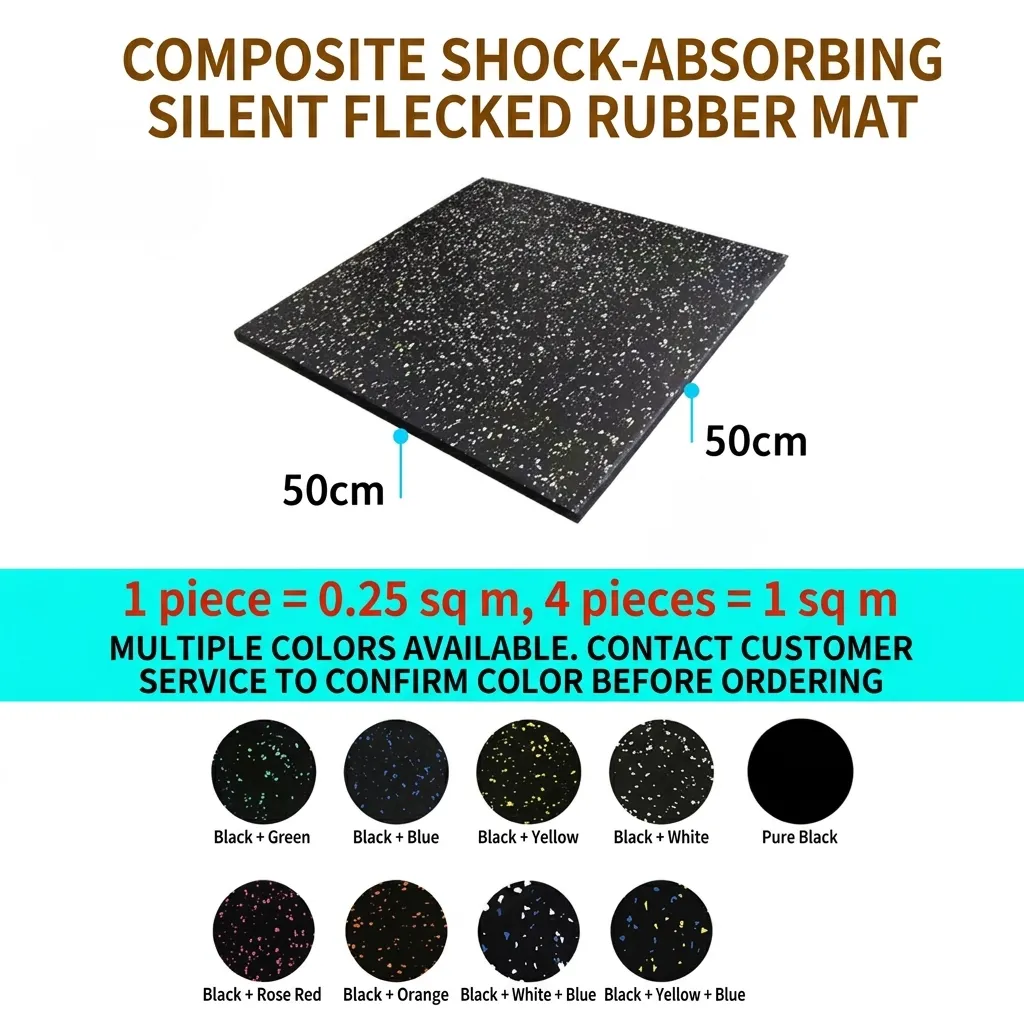
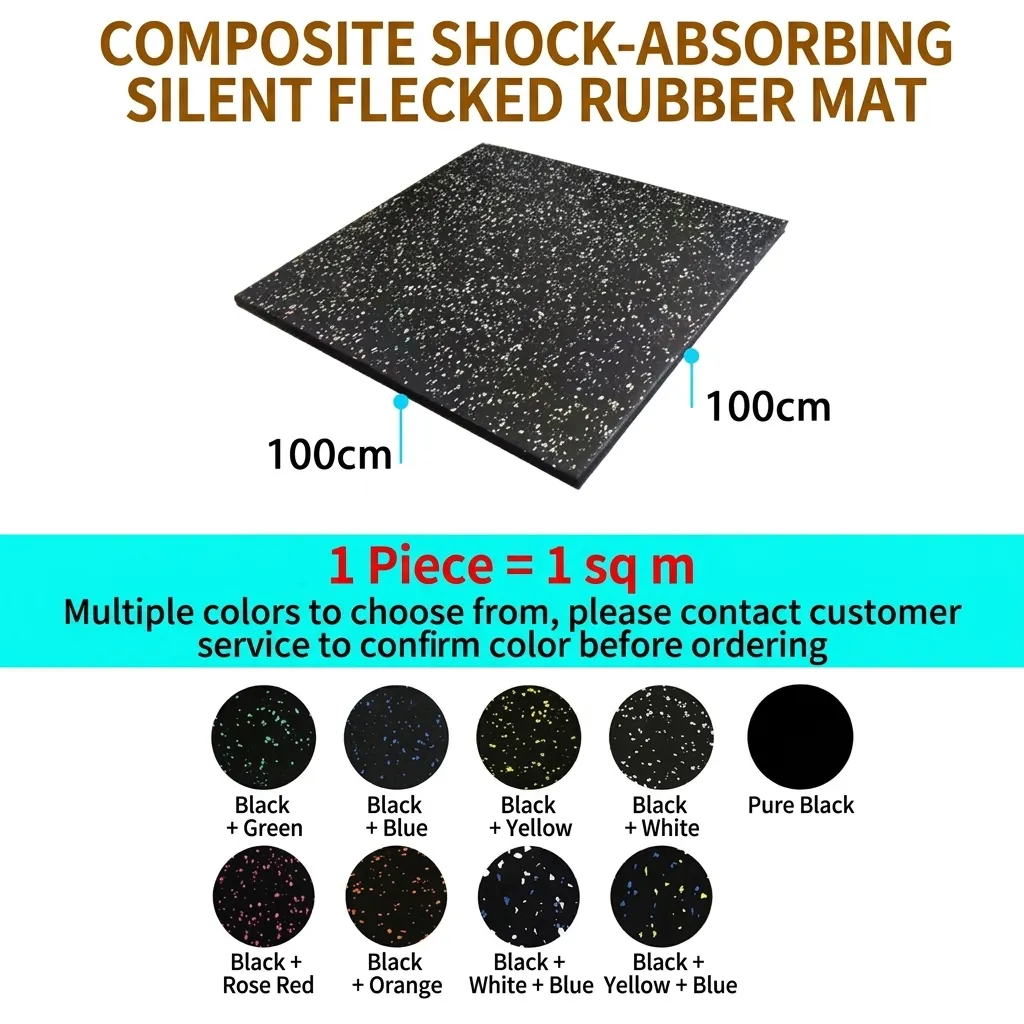
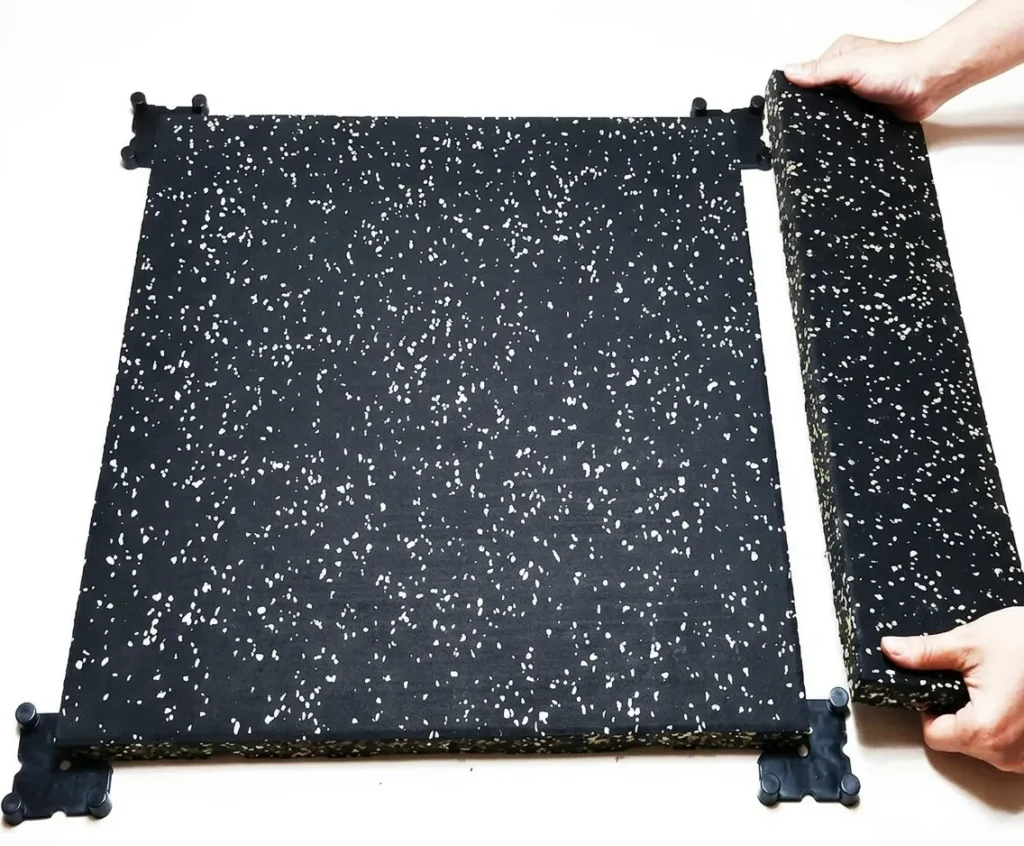
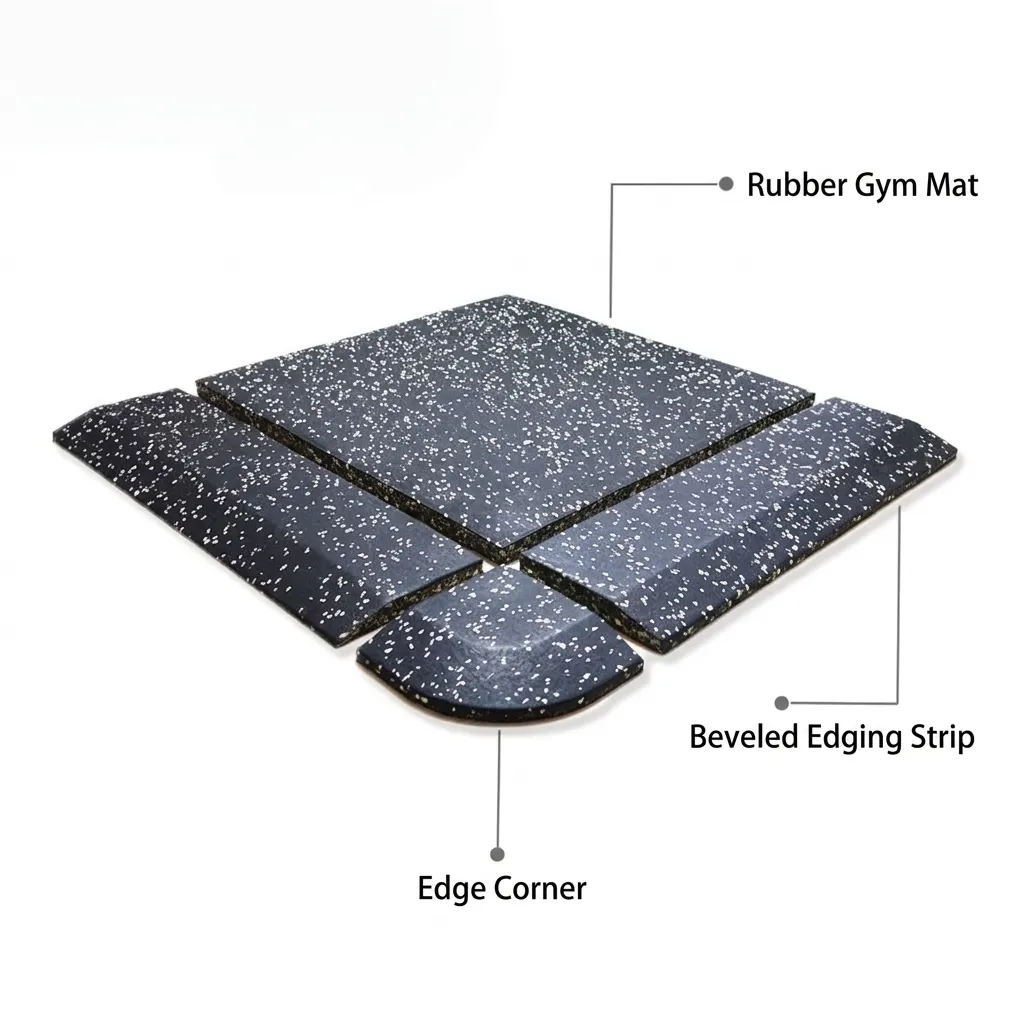
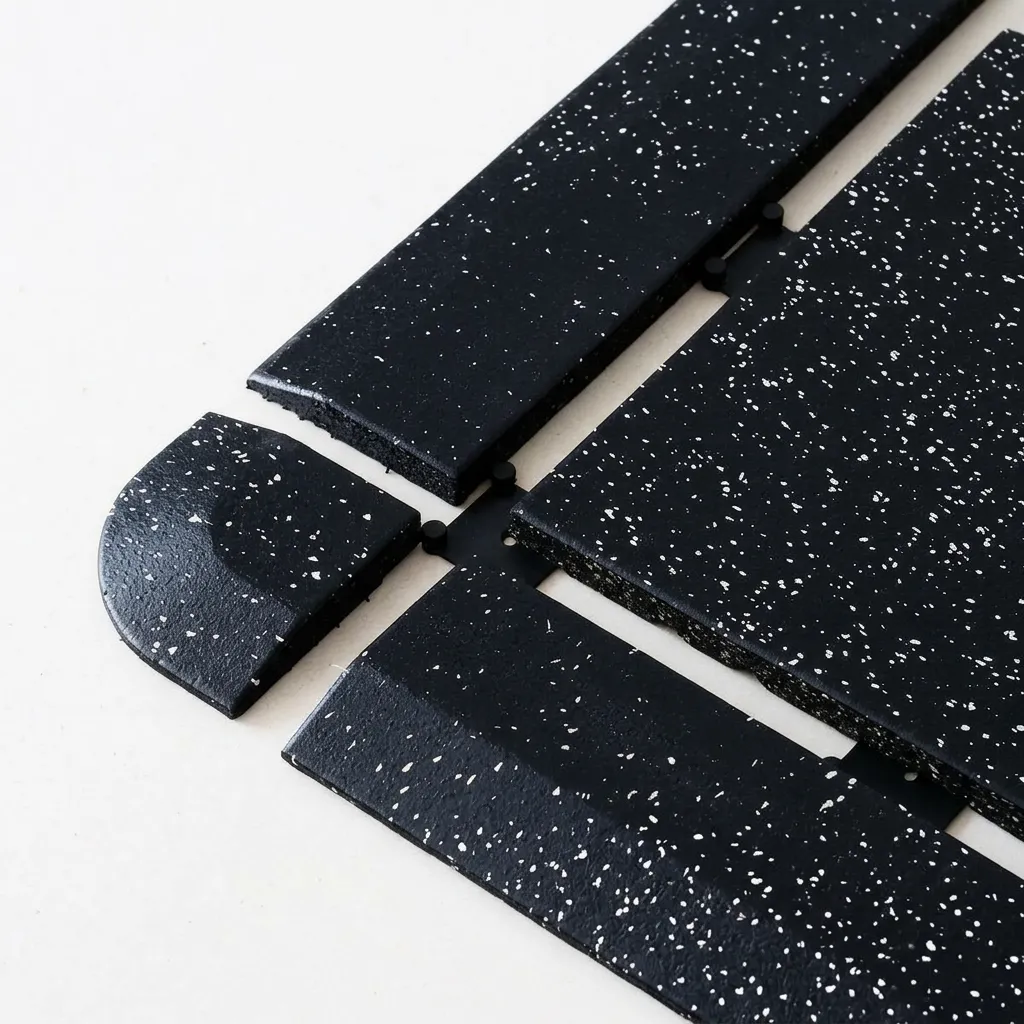
Our commercial interlocking EPDM rubber flooring and composite gym mats are built for the busiest part of a gym floor – the free-weight area, the lifting platform, the sled track. Each tile is a two-layer composite: a high-density EPDM wear surface bonded to a recycled SBR base, so the top layer takes the abrasion and the base absorbs the impact. We press them at our Hebei factory in 50 × 50 cm and 100 × 100 cm formats, from 15 mm to 50 mm, in interlocking or flat-edge versions.
Full specifications for commercial interlocking EPDM rubber flooring
| Specification Item | Technical Details & Standards |
|---|---|
| Product Name | Composite EPDM Rubber Gym Mat |
| Connection Style | Interlocking Model / Flat-Edge Model |
| Fire Retardant Rating | Class B1 (GB 8624-2012) / Class Bfl-s1 (EN 13501-1) – Flame Resistant & Low Smoke |
| Surface Material | High-Density EPDM Synthetic Rubber Sheet with Color Flecks |
| Base Material | Recycled SBR Rubber Granules |
| Dimensions (L x W) | 500 x 500 mm (50 x 50 cm) / 1000 x 1000 mm (100 x 100 cm) |
| Thickness Range | 15 mm to 50 mm (5 mm Increments) / Custom Thickness Supported |
| Density | Surface: ~1400-1500 kg/m³ | Base: ~900-1000 kg/m³ |
| Hardness (Shore A) | Surface: 65±5 Shore A | Base: 55±5 Shore A |
| Key Features | Shock Absorption, Noise Reduction, Stain Resistant, Anti-Slip, High Durability |
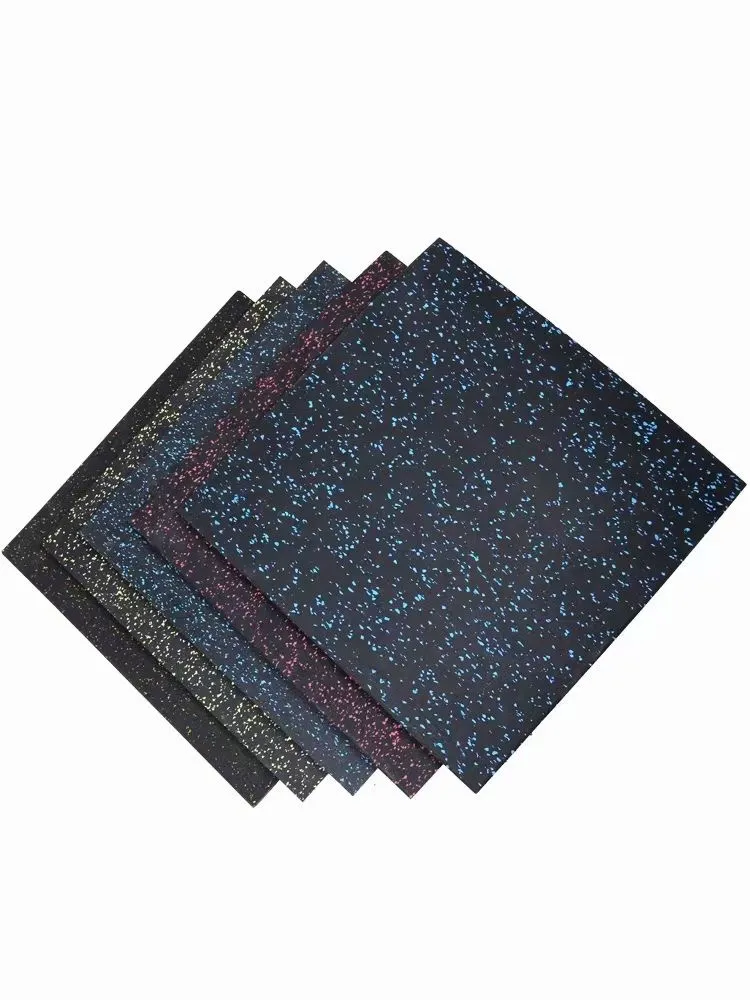
| Color Variations | Pure Black, Black + Green, Black + Blue, Black + Yellow, Black + White, Black + Rose Red, Black + Orange, Black + White + Blue, Black + Yellow + Blue |
| Applications | Commercial Gyms, Powerlifting Zones, Crossfit Boxes, Home Gyms, Fitness Clubs |
| Customization (OEM/ODM) | Custom Colors, Thickness, Dimensions, and Packaging Available |
Why the two-layer build matters for EPDM rubber gym mats
A single-layer rubber tile has to compromise. It needs to be soft enough to absorb a dropped dumbbell and hard enough to survive chalk, iron plates and a decade of traffic. Separating those two jobs is what makes a composite mat work. The EPDM wear layer sits at roughly 1400–1500 kg/m³ and stays dimensionally stable under load, while the recycled SBR base at roughly 900–1000 kg/m³ does the energy absorption. The floor protects the slab underneath without turning spongy beneath a squat rack.
Both layers are pressed and vulcanised as one tile, so there is no glue line to fail and no delamination when the floor is cleaned daily or hit by sunlight through a window wall.
Which thickness suits which training zone
Thickness is a function of what falls on the floor, not of how the room looks. As a working rule for commercial projects:
- 30–50 mm – free-weight areas, powerlifting platforms, dumbbell racks, anywhere a loaded bar can be dropped.
- 20–30 mm – functional zones, sled lanes, box-jump and medicine-ball work, where impact is frequent but lighter.
- 15–20 mm – cardio rows, selectorised machines, group-class studios and stretching areas.
- 15 mm plus edge profiles – circulation space, entries and any zone that has to meet a hard floor.
Zoning a single gym across two or three thicknesses is normal, and it is usually cheaper than over-specifying the whole slab. Our commercial gym rubber flooring guide walks through the zone-by-zone logic with worked examples.
Interlocking or flat-edge
Interlocking tiles are the default for leased buildings, event spaces and any floor that may need to come up again: the clips pull seams tight without adhesive and a 200 m² floor can be lifted in an afternoon. Flat-edge tiles are laid tight or glued, which gives a cleaner line in permanent installations and makes wall-to-wall coverage easier to finish.
The composite build is identical in both versions. What changes is the edge profile, the way the perimeter is closed, and how much of the flooring accessories range you need to order with the tiles.
Installation, edges and maintenance
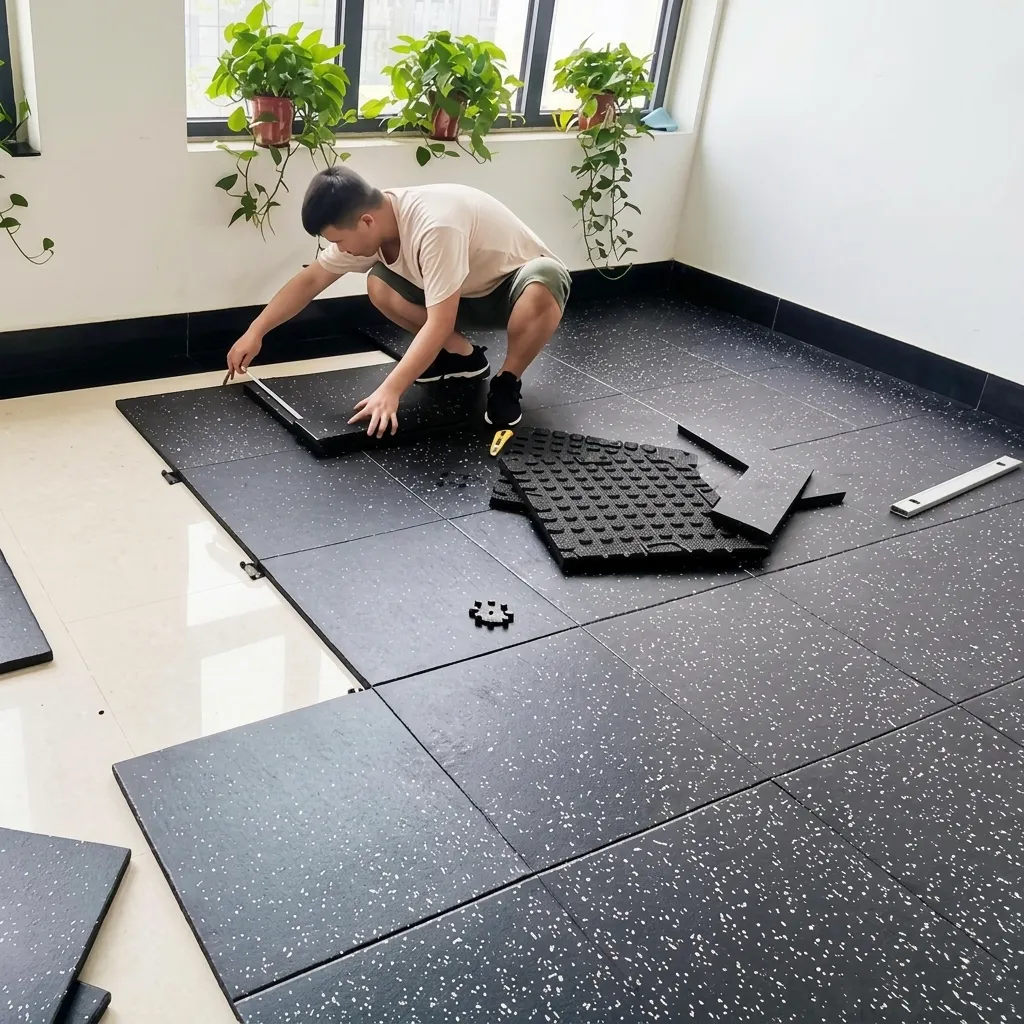
- Let the tiles acclimatise in the room for 24 hours before laying, especially in new buildings with high residual moisture.
- Start from the longest straight wall and dry-lay a row to confirm the colour pattern before you commit.
- Interlocking: seat a connector on every shared edge seam and close the joint with a rubber mallet and tapping block.
- Flat edge: bond to a level, fully cured screed using a rubber-flooring adhesive rated for the substrate.
- Finish every doorway and change of floor with rubber flooring transition strips so there is no tripping lip.
- Clean with a neutral pH detergent. Solvent degreasers will dull the EPDM surface and are not needed for chalk or sweat.
OEM, colour matching and container supply
Distributors and gym chains rarely buy a stock tile. We match brand colours with EPDM flecks, cut non-standard sizes, print private-label packaging and consolidate mixed containers of mats, EPDM gym rubber flooring rolls and accessories so a single shipment covers a whole floor. Daily capacity at the Hebei plant is around 5,000 m², which is what makes short-notice project volumes realistic.
If you are comparing options, multicolor composite gym rubber tiles uses the same composite build with a wider colour range, and high density outdoor rubber mats is the version specified for uncovered outdoor areas.
Frequently asked questions
What is the difference between composite and single-layer rubber mats?
A composite mat bonds a dense EPDM wear layer to a softer recycled SBR base, so abrasion resistance and impact absorption are handled by different materials. A single-layer tile has to trade one against the other, which is why it either wears through or feels too hard underfoot.
Can these mats be used outdoors?
The EPDM surface is UV stable, but a composite tile is designed for indoor commercial floors. For patios, outdoor rigs and playgrounds, specify high density outdoor rubber mats instead.
Do the tiles need adhesive?
No for interlocking tiles – the connectors hold the floor together and it stays removable. Flat-edge tiles are usually bonded, and adhesive is recommended anywhere the floor takes sliding loads or heavy trolley traffic.
Can you supply sample tiles before an order?
Yes. We send surface and base-layer cut samples in the colours you are considering so your client can approve the finish before production.
Tell us the zones, the total area and the finish you need, and our export team will come back with a thickness breakdown, a packing list and a quote. Browse the rest of the rubber flooring tiles and mats range first if you are still comparing formats.
Get a quote from the factory
Need a thickness breakdown or a sample of our composite EPDM mats? Tell us your zones and total area — our export team replies with a quote, packing list and lead time within one working day. Contact our export team or request a free sample to check the finish before you order.